Wednesday, December 31, 2014

3 days of...Awesomenauts!

Action platforming MOBA at it's finest

I have been a fan of MOBAs for most of the year now. My work doesn't take me near human contact for most of the day. So when I get home and look for some qualifications of the games I want to play, multiplayer is a definite attractor. Thus, MOBA is a natural genre for me to ease into and get some much needed human contact, no matter how venomous the comments. 

Honestly though, I was suprised when I picked up Awesomenauts by Ronimo I jumped right into a game after lightly reviewing the mechanics and controls. The game lends itself to a fast learning curve at least at first. Much of the game is fast and twitch reflexes are necessary, but a basic knowledge of MOBAs and action platforming are all the basis you need to have fun in your first games. 

During my first game, I felt as though I wasn't even playing with humans. You are constantly moving and jumping, controls which take both your hands, and every second counts since the arena is much smaller than most MOBAs. So there wasn't much time to type, and as far as I could tell there wasn't voice activated from allies mics. It is quite a different experience to play with the basic communications that are provided by the game. Each of the several number different buttons that are quickly accessible allow you to communicate ideas that are basic to every MOBA. Retreat, attack, help, and the like are all communicated through generic terms to your teammates instantly. Fortunately there aren't sarcastic or abrasive comments that can be communicated so quickly so the entire thing turns out often to be relaxing and fun, even if you end up losing. There is of course a chat option, but I found it unnecessary and not often used by others either.

The mechanics of battle remind me of platforming action akin to Smash Brothers. Though unlike that genre, special abilities have cooldowns. So you can use them as they come available, but are disabled for some time after their use and you are left with just a simple attack button. Fusing the two concepts actually works very well. The most important aspect to combat then is positioning and timing. This allows for a very gradual learning curve after beginning to learn the game, eventually breaking into the concept of meta and having to change your tactics based on the current trends of combat and the game. So even though the game might be more simple than say DOTA, it still has a sense of depth. 

I will thank the creators for breaking down the timing of modern MOBAs because the constant stress of being put against other humans, and having to remain evasive for more than 20 minutes in an action platformer can be very strenuous on my hands. Luckily, rarely did a match extend beyond that time. It seems to be the median time that you can spend in a game, many ended before that as pushing strategies were involved.

Other great things that I enjoyed about the game: The reduced dependance on items (though there are some tactical choices in your purchases), faster respawn times, unique characters, and a great system for cosmetics. Cosmetics are a big attractor to me for a MOBA, as they are a way to customize the game to your preferences. I think the art style is very appropriate, and many of the cosmetics are either comical or very well constructed for the character type. Some immersion is broken for some of the cosmetics, like the minecraft model for one of the characters. However this is a game that never takes itself so seriously as to not allow for such concessions. 

I enjoyed my time with Awesomenauts and I will be glad to come back to it as a game that has a lot of replayability. Not only that but the development team are still working on creating new and interesting characters and cosmetics. Even developing the AI to be better on a consistent basis. So even if you purchase this game now, you won't be disappointed with the future prospects. This is definitely something to look into if you enjoy MOBAs but need a break from the seriously competitive play that pervades the attitudes of their populations.

You'll like this game if: you're tired of more serious MOBAs but don't to leave the genre entirely behind. Great gameplay, fun characters, and quick matches are the star qualities of this game.


(If you had a different opinion or a new video game to suggest, leave a comment below! If you want to recieve regular updates, follow me on Twitter @SimonGolden. )

Saturday, December 27, 2014

3 days of...Call of Juarez: Gunslinger!

Arcadeology

Westerns are a touchy subject for me. I never desired to marathon through spaghetti westerns or the American classics involving smoking guns in the title and the action sequences. I was lost when actors donned makeshift rope and cast iron armors at high noon. As a matter of fact my introduction to the setting was Red Dead Redemption on the PS2, so naturally my critical eye was ruined with a glorious example of how a Western SHOULD be made. 

Even though it's a few years old, the game still looks great.
Yet those precedents didn't prevent me from enjoying Call of Juarez: Gunslinger by developer Techland. I hadn't known many of the historical outlaws that were referenced, and was not familiar with the character tropes that scattered the mythology. I was good at arcade shooters though, and by the time I was done, I was thoroughly engrossed in the story of Silas Graves. Playing the part of a great mercenary and involving myself in the legendary stories made everything feel larger than life. 

There are a great many details that are paid attention in Gunslinger, but few stand out as amazing decisions on the developers part. The well balanced combat, bullet time feature, duels, and arcade style all stood out to me as the best part of the game. The rest of the game was very well put together, had a quality finish and a narrator that was very entertaining. The narrating is done by the main character over a game of poker and a few drinks, so while you're shooting away at outlaws and Apaches, you may be stopped to make corrections in the story. Set pieces fly from the sky, the ground opens up, and enemies are replaced or multiplied on a regular basis. This keeps you on your feet and makes the game much more interesting than most story-based shooters that I've ever played. 

The narrative can be both engaging, and erratic at times.
That being said, the quick bait-and-switch of the narrative combined with the quick reaction required to create combos makes for frantic game-play. It is not constantly frantic however. The fights are placed well apart so the attention required to create massive combos is staccato and focused in intense portions that are manageable. Narrative is delivered mostly in the slower gaps between combat so you don't miss any important story elements. Still though, the combination of arcade gameplay and the constantly changing landscape and narrative is fresh and personally I laughed every time my slightly sloshed memories were changed.

There are likely 2 ways that you might approach Gunslinger. The game encourages long-distance cover to cover sniping, and quick running reactive close-range game-play. The best part is that both are viable, and you aren't incentivized or punished too heavily for choosing one over the other. The bullet time feature is one of the ways they balance this. There is both a bullet time feature for combat, and a final bullet survival dodge that is activated when you are about to be hit for the last time. So you don't have to worry while your bullet meters are filled when you can run and gun. However you are risking life and limb once you dodge the bullet (literally) and need to recharge those meters!

These duels really make you feel like you're racing to draw.
This design choice both makes the stories more faithful to the stories of larger than life personalities and makes sniping and close-range combat both rewarding and effective. Instead of applying MORE armor like most games do, they increase or decrease these bullet-time features to give closer-combat more flair and effectiveness.

After playing this game for just a few days, regardless of how high I am on the leader-boards, everything becomes smooth and natural. Bullets fly, enemies fall, and my tally increases. I am not the best in the world, but it feels as though I am the best in the world I am playing in. This feeling that the game bestows on it's user is unique and gratifying. The only word I can use to describe it is "bad-ass". Yes, I feel like a bad-ass after playing Gunslinger. 

You'll like this game if: You want to be John Wayne and Clint Eastwood on steroids, mix in a bit of matrix, and a dash of space-invaders. Cook at 350 for 4 hours, and consume like nails at breakfast because you feel like such a beast.

(If you had a different opinion or a new video game to suggest, leave a comment below! If you want to recieve regular updates, follow me on Twitter @SimonGolden. )

Monday, December 22, 2014

3 days of...Assassins Creed III!

A Lesson in History and why NOT to repeat it.

The British are coming...
With the impending annual schedule of the Assassins Creed series, I decided to continue on my way through the episodes. I've already played up to the 3rd in the series, including Brotherhood, and I wanted to see how the series was holding up before moving on to the fourth. To be honest I am sincerely looking forward to play a pirate assassin in the Caribbean, regardless of the technical issues associated with the game. Slogging through what has a reputation as being the most flat game of the series is just something I had to do for continuities sake.

No spoilers, but you kill a bunch of redcoats.
It is very flat. The opening sequence was surprising, but it takes too much time for the sake of the story. The main character should induce some emotional reaction in me, but he is distant and inhuman. His reactions are inappropriate for the circumstances most of the time, and I believe this is the biggest problem with the character. Let's be honest, if I can't relate to the main character and his struggle it becomes more and more difficult to pick the game up time and time again.

There are other ways of doing this rather than introducing emotionally drawn out sequences that are meant to be motivational food for the character. Countless other games have a silent protagonist that I identify with more, probably because I can introduce my own voice as I play the character. No, the dissonance that is established by the time real game play comes around is so pronounced it is impossible to recover from.

Here was the first glitch I came across.
Floating Cannonball!
The reactions of other people to the main character are also unbelivable. Names like Sam Adams, George Washington, and Benedict Arnold are commonplace. But their reactions to a Native American running critical messages, assassinating leaders, and commanding troops is unbelievable. Not that a Native American isn't capable of these things, it's that at the time there was such cultural stress that the looks and attitude in the game don't match what I would expect. Shattering my expectations from history destroys my immersion. I know that since it is a game it isn't supposed to be accurate, but accuracy in some things is necessary for immersion. Especially for an alternate history series no matter how they may change things around. It is a difficult balance to hit, but missing the target all together isn't an option for a major studio like Ubisoft.

So there you have it, my two biggest complaints with the game. I'll leave it there, because there are so many articles about the technical issues plaguing the series. Hopefully I can be more enthralled by future installations of the series, and get back to the feelings of wonder that the second game left me with.

3 days of...Binding of Isaac: Rebirth

A Lesson in great Design

I have had my eye on Binding of Isaac for quite some time, being a fan of roguelikes. I played the original version a while ago and fell in love with the concept. The way that Edmund McMillan integrates the Biblical mythos in a way that is both coherent and creepy. Not many games can pull that off so obviously, and even though it may be offensive to some modern day Christians, I still find it a refreshing departure from the revisiting of greco-roman mythology that invades the market these days.

However, I want to talk more about the design of the game. It is done in a way that is reminiscent of Legend of Zelda two-dimensional dungeon crawling. Each room has its own dedicated screen and the screen moves as you move between rooms. The combat is a mixture of bullet-hell and top-down shooting mechanics. There are power ups, boss fights, and secret rooms. Everything that makes up the standard dungeon crawler.

The real treat though is that the randomized synergies between weapons and items are just in-depth enough to both keep old-time fans coming back, and amaze newcomers alike. There was one run through the game recently that I had floating, piercing, explosive tears (the bullets the characters use) that expanded while they were mid-air. This is just one run and I guarantee I will never have another like it.

These synergies keep you coming back over and over to see how you can combine items or break the game every time. The excitement that you may over the course of 45 minutes become so powerful you can kill anything with your sweep of bullets is so strong that the fight to get there is worth it. And that's basically what the game boils down to. The fight to become overpowered.

Due to random chance and the game generating seeds though that isn't always possible. It doesn't keep you from turning around and trying again to crawl your way ever closer to being "carried" through the game by the right combinations of items. This feeling is one of the reasons I kept coming back to Binding of Isaac. It's strangeand addictive, and even when you're losing, very very fun.

The rest of the game has the same theological feel of the first Binding of Isaac game, something I enjoyed immensely. The current remake is 3 times the price, and after playing it for some time, I have to say the added items, characters, and the improved efficiency make the price tag worth it. If you're a fan of rogue-likes then this game is a definite must-play. It even has a multiplayer element if you don't want to shell out the money to check it out.

You'll like Binding of Isaac Rebirth if: You enjoy bullet-hell style shooters and want an infinitely variable game that never shows the same iteration twice.

Thursday, November 27, 2014

6 Days of...Kentucky Route Zero!

Surreal doesn't begin to describe it

It's strange how sometimes playing a game relates so deeply with your current situation that it feels as though it was made specifically for you at that moment. You get a pit in your stomach and when you stop playing you see the world in a whole new light. Perspective changes and you just feel as though a weight has been lifted off of you when you turn your attention away from the screen after that last pivotal plot point. 

Personally I am going through an extended transition from previous Military experience, then school, and now a professional career with a family, life can be pretty confusing. That confusion has nothing on Kentucky Route Zero by developer Cardboard Computer. There are words that can describe the game: surreal, strange, odd, uncanny, bizarre. You can describe the things that happen in the story by sequence, but completing the ideas as to how or why these things happen is impossible. 

The game itself isn't so much a game as a series of events that captures you and allows you to shape the adventure and it's contents as a concept of your own design. The events are all going to happen regardless of whether or not you make certain choices, the only thing that may change are dialogue options and responses. You even begin to have conversations with yourself through multiple characters gradually. This is interesting because now both sides of the conversation have different possibilities, and somehow the conversations seem less mechanical even if they are with yourself. 

Going back to describing the game, there are words to describe it, but each of those words seem to have connotations that don't fully encompass the ideas portrayed. The feeling is fuller, than those words can describe. It's very odd, and I don't want to give any of it away as a spoiler. 

Things that are strange and unbelievable happen and the characters seem to take it with a grain of salt. Things like traveling on an inter-dimensional highway with arbitrary markers made of everyday items, replacing a leg with a metal skeleton prosthesis (and not reacting), taking a shot with a skeleton with a tape recorder, flying on a giant eagle that moves houses daily. These are all taken by the characters as something completely acceptable if a bit odd. No explanation of why these things are happening, just that they do. 

There is no time or place to explore why these things happen, so taking them with stride is forced on the player as well as the characters. You can only move forward and there are no places to take breaks to look for answers. So you derive the answers from events as they move along, and accept what doesn't make sense, and just move along. Eventually events in the story that didn't make sense are after the fact, and become a part of the plot. So even surreal happenings can become important regardless of how illogical or insane they seem at first. 

The entire interface is a point and click adventure, but there are only so many things you can point and click on and they are all labeled for convenience and to keep the story moving at a reasonable pace. This doesn't detract from the experience, as the game itself is surreal enough to keep you entertained. If anything it keeps things interesting as you always want to move forward to see what strange happenings are next. 

The strange is the spectacle. And the glass through which you look is your own mind. The experience is engrossing. 

You'll like this game if: You enjoy M.C. Escher and Picasso, and want to play a game designed by them. Strictly for those though that enjoy being told a story, and not necessarily molding it.


Saturday, September 13, 2014

6 days of...Broken Age!

Time well spent

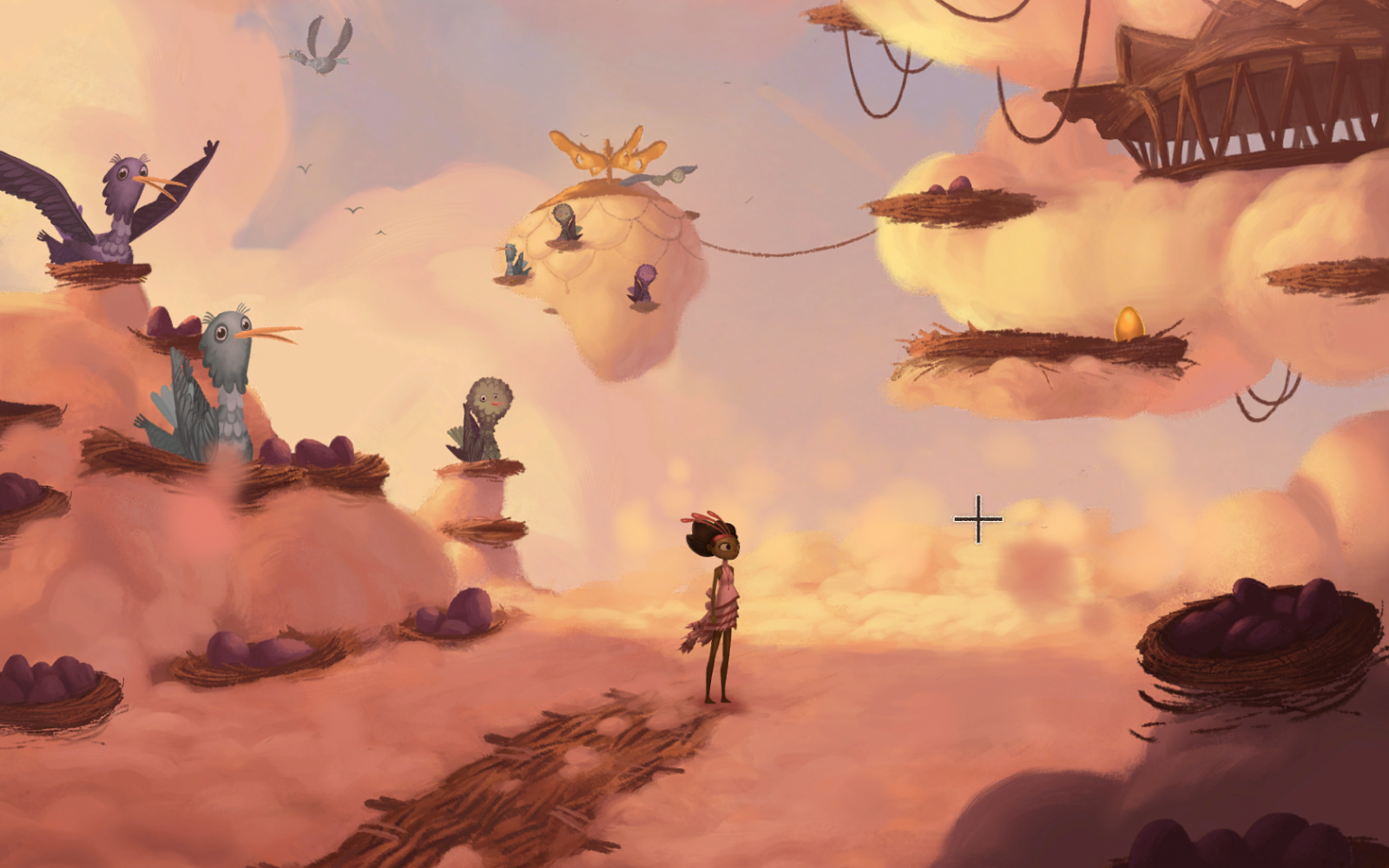
Sometimes it's good just to get back to my roots as a gamer. I loved the Sierra point and click games from the 90's and somewhere in me I will always hold an attachment to those types of games. So when I heard that Double Fine would be releasing a point and click adventure called Broken Age after a VERY successful kickstarter I got excited. I loved Brutal Legends when I first got a taste of Double Fines work and I am definitely going to check some more of their games out after this. 

This is the prison that you have lived in your entire life, and the
game makes you feel this immediately without feeling forced.
Speaking of that Kickstarter, it was setup for 400,000 and made over 3 million. That's just nuts. The dedicated community behind Double Fine games just astounds me. They demand nothing up front because they believe that there will be a quality product coming from the money they donate. That speaks volumes to me about the faith and confidence the community holds in this company. If they decided to go more mainstream I think they could make a lot more money, but they would definitely lose a bit of their following. Too bad though, seeing a Call of Duty style budget go to Double Fine might get some amazing things accomplished.

Anyway, back to my time with Broken Age. I can honestly say it has got some of the most memorable and smooth transitions that I've experienced in point and click adventures. Often playing a point and click is like having a conversation with someone that spoke into a microphone years ago, and is expecting you to respond correctly in the future. It's a difficult disconnect to overcome and many games fall short. An example of this would be adventures that reference or give clues to your next action, but in a much more obscure way than is necessary so the player ends up not understanding.

These portions of the story add incredulity and whimsy
but are engrossing at the same time.
However in Broken Age, it was neither obvious or obscure what action I was to take next. It was a perfect balance of clues and discovery. It felt like the world spoke to me and I responded each time, instead of being led by an overaggressive partner or abandoned to my own means. It was a genuine conversation between developer and player. In which no side came out stronger than another. 

I would attempt to bend the world to my whim, and the game would calmly direct me back to a path that was more fitting. I would push and strain to accomplish seemingly impossible things, and instead of getting frustrated I would just stop and enjoy the scenery. After a short period of time the answer would just come to me through an epiphany not brought on by an obvious hint but seemingly by my own intuition.

Instilling this in a player is a very, VERY difficult thing to do. It is a mystery to me how they did it, but Double Fine made me feel like I was genuinely exploring a new world and overcoming challenges by my own intellect, and not just stumbling along my way through a story. 

That being said the art is incredible. It's not detailed or special by any means, but the washed out pastels and some of the color changes between scenes really sticks out. The art also lends itself to the story because of the environments you find yourself navigating. The art makes each scene look like a children's story, but the story is much darker in context than the pictures would describe. It has a very Grimm feel to it. The story itself is dark and in some ways shocking, but it juxtaposes completely with the optimistic color and youthful art style.

This doesn't give anything away,
but I was frozen in shock at this point of the story.
It's hard to describe in some ways why it is so good, but if you enjoy point and click adventures, you should pick this one up. There will be more episodes soon but for now the game only takes about 5 hours to complete. That is only one episode though and there is at least a second episode promised to add on to the current story.

You'll like this game if: You enjoy point and click adventures and love stylized art an amazing speculative fiction story that will keep you enthralled for hours.

Sunday, September 7, 2014

6 days of...Mass Effect 2!

Everyone told me it would be great..

And in many ways it was. Mass Effect 2 by Bioware takes after it's predecessors that I've played. Since I picked up the game on a Steam sale and it's brethren were not so lucky to be discounted, I haven't played ME1 or ME3. So I don't have the save file that transfers the consequences of your actions or anywhere to go after I beat the game. But I have played previous Bioware games like Star Wars: Knights of the Old Republic, and more recently Dragon Age. I like Bioware's formula for games and especially the depth of story that they establish to create an all encompassing world that seems complete and detailed. 

Everything about Mass Effect 2 was great to experience.
Mass Effect 2 is no exception. Bioware put their heart and soul into this game and it shines through nearly every game play element. I thoroughly enjoyed playing it. What else is there to say about how good Mass Effect 2? It's pretty much been summed up in so many written and recorded reviews that there isn't much a single person could say that hasn't been said. 

That in mind, I think that there is something to be explored about the mechanic of choice as portrayed in the Mass Effect universe. This is something that has been touted as one of the accomplishments that Bioware is known for. Creating choice and consequence in a space opera that not only affects you and your team but an entire universe. How real is this choice though? Is it strong enough to break free of pre-determined course? Or just strong enough to create the illusion of choice? 

Free Will: Illusion vs. Reality

I will try to deny plot spoilers in this discussion, and instead focus on generalities. Strictly speaking you begin Mass Effect 2 as Commander Shepard and due to some circumstances are bound to the illusive man to help save humanity and the universe by revealing and exploring ways to defeat the Reapers. Starting out you are immediately tied to the destiny of a group of individuals and are made responsible for the survival of the universe. 

Of course it's implied multiple times that Shepard is the only one that can unite and save everyone. And so the responsibility is solely placed on your character. This is just the first choice that is denied you, the choice of responsibility. However that choice was made before even loading up the game, as you the player are already taking into your hands and putting on your screen a universe that you are taking responsibility for. Consent to become a savior is implicit in installing the game. It is your choice to play and when you play you are bound by the rules of the world you inhabit, the first one being that you must save the universe or doom it. That is your burden. 

Do we choose this path? Or is it chosen for us?
This non-choice at the beginning then is a real choice that was made by the player prior to playing the game. One might argue that you cannot choose to stop and do nothing in the game, and so it is illusion instead. However, this game is a STORY with a PLOT. It is not a simulator, as universal and ultimate choice would create. The parameters of the story are established and the choices after that are given to you are part of those parameters. One consideration is that in a story there can only be so much deviation before it loses its plot. 

Plot devices can change in minor ways but they cannot change in any way you decide to choose. Certain choices lead to consequences, but there must be some continuity in the main plot line along the way. Playing through the game multiple times, you end up in the same fights, with the same people. Often the only difference is replacing one character with another. In some scenes you are given a choice to magnanimously let people live or exercise wrath and cold calculation as you watch people die. This life and death scenario brings with it a deep sense of consequence to the choices presented. It is a part of our psyche to be impacted by death, especially of characters we are invested in. Is this choice real though?

The characters have minor plot devices in their backgrounds, and you can act on those plots to help them. You may even establish a friendship or relationship with some of them. The bond that Sheperd forms with these characters seems real and plays out with emotion and drama on the screen. So in choosing to let them live or die you break or strengthen that bond. Is that choice an illusion though? even though it has such an impact? 

I personally believe it is because of one train of thought. Implicit consent to become a savior of the universe puts you on a single path that must reach culmination to respect the boundaries of the universe you inhabit. By this I mean that beginning the game and accepting its terms implies that you will eventually finish the STORY that you have begun. Otherwise the initial choice is pointless, as the journey to the end of the story is the point of beginning it in the first place.

Once begun, the journey you are on places you in situations and gives you choices to develop the outcomes of lives around you. However regardless of your choice the fate of the universe will still be on your character, and the situations and missions you take on will continue to be very similar to what they would be regardless of choice. For example: a world may die because you did not cure a disease, however you will still fight that giant robot guardian on the next world with all or some of your friends. This robot is a plot device and an obstacle that needs to be cleared to satisfy the code requirements to continue the story. Are you affected by your choice? Possibly, but ultimately the choice does not matter as you continue on meeting these plot requirements. They are like domino pieces, and beginning the game pushes the first domino without any way to stop them from falling without just walking away.  

Final Questions

When does the illusion disappear and we believe this could be us?
This realization may be normal. Everyone might have it when they play games similar to this. What other devices are mere illusions in games? Using the same logic and exploring other devices we can show that everything is illusion in games. The improvement of skill in games is illusion because you are not actually improving, just increasing a number in a memory byte. The improvement of quality in graphics only improves as far as you can continue to create an illusion for the player, and the subjective opinion of graphics is relative to previous experience. So when does the illusion become reality then? When we cannot recognize the illusion? When does the change from illusion to reality occur? The difference is so subtle that we may not know until it is done, and then games will not only be a part of our lives, but may become our entire lives. If you experience something that is so real that you believe it to be reality, does that not constitute the definition of reality itself? The reality is that the thinking part of ourselves is only experiencing electrical pulses from the rest of our senses. If those electrical pulses can be manipulated and changed to suit a game, where does the boundary of illusion and reality exist? 

Going too far, bringing it back

These are some of the things I think about when a game gives me something that resembles "choice". Believe me, I think it's amazing that I can feel for digital bytes in the way that games like Mass Effect makes me do. I enjoy the choices and playing god, it's one of the reasons I play games in the first place. Being powerful is intoxicating, and playing games is the one of the best ways to do that. Mass Effect 2 definitely does that for me, and then some. It also has some great powers that are flashy to show off! You can even shoot a black hole at people! Don't tell me that's not awesome.

You'll like this game if: You enjoy space opera science fiction and like light bloom effects on literally everything. You may also enjoy the illusion of choice without having it or shooting black holes at people.