Showing posts with label News. Show all posts

Sunday, November 1, 2015

A rant on Elite Dangerous before I review it next week

Thank you Frontier, from a fan of space-sims


About 10 years ago when I was just venturing out on my own into the unknown world for the first time. At that time I picked up one of the first games for PC that I earned myself. I am proud now that I chose Freelancer for my first PC game back then. Granted I had played PC games but they were always on my parents PC or a friends. This was my first PC and the first new game I played on that PC. It was amazing. The degrees of freedom in that space simulator were above and beyond anything I had experienced before. If you haven't played it before I highly suggest trying it out because it truly was one of the best games of it's generation and garnered a huge community and brought a lot of young adults from my generation to the genre. 

Every time you jump your first introduction is to the local star
(white dwarfs and black holes included)
Then years passed, I did a stint in the military, and became a father. After some time I forgot how much I loved the space-sim genre because nearly no quality games came out in that time period that gave the definite experience of space travel. Then in 2013 Star Citizen and close after Elite: Dangerous were announced and I got very excited. I wanted to follow the development of the games and for a time I did. Then some months passed and I happened to forget about my dogged devotion to developer diaries until Elite: Dangerous appeared on sale on Steam a couple months back. So I picked it up and put some time into it. I also got involved in discussions on reading boards and delved into the community.

What I discovered is that the community is half the game. Some of the content of the boards are focused at the developer but other content are just stories or arguments between factions. Cries for help from traders or requests from bounty hunters are met with the in-game terminology and much of the advice is phrased as if it were given freely between Commanders. This community building isn't something I'd seen since Freelancer in Space-Sims (some might argue that EVE Online has a much bigger commitment to community but I don't consider that quite a space-sim. I'll explain in a later article).

The community involvement is important because this game is an MMO Space Sim. That and there is no story mode. The trade off is that there is a life-size galaxy to explore. Something like 400 million different systems to visit. All completely generated and logged for exploration. This means that the entire game and your own personal progression is up to you entirely. There are so many things to do that it was immediately overwhelming for about a week for me. Trying to figure out what I needed to do and how I needed to go about getting money was work in itself. The same way that you might research how to get a job or do said job to get paid. It was very much a reflection of real-life in a space-simulated environment. 

Sights like this are regular, and always amazing
For lots of people I saw on the boards and have talked to it seems that this is not very "gamey" from the developers. The main complaint is that they've created a wonderful environment for a game to take place in but haven't included much of a game. However I find that this kind of dedication to world (in this case galaxy) building has been lost over the years, and to see Frontier be so dogged in pursuing this type of purity is refreshing. No there aren't any story elements unless you count paragraphs of text from mission boards or political posts. However if you were sitting in your ship at dock this is how you would access this information anyway. There aren't many (or any) open comms online unless you count between other commanders, but that may well change in the 8 years left in the development cycle of the game. 

That's right, the game has a 10 year development cycle plan. There are going to be annual "season passes" that allow access to the next years worth of development content. To some of the backers this leaves a bad taste in their mouth which I can understand. The wording at the beginning of crowdfunding made it appear as though the first purchase would lead to the entire games worth of content. However after a few months the next "season" was announced which made a lot of people leave cursing Frontier. 

I personally don't have a problem with the next few years of content being behind season passes. I see it as a very complete game as-is and if you want to add on to that by paying for some new content (some of which will be implemented with vanilla anyway) then you can. Otherwise you can play the vanilla game that you paid for. This is viewed as catering to the corporate greed by most, but I see a 10 year development cycle and understand the ridiculous amount of raw cash that will take and what kind of endeavor this is. It's insane. Really it is. If you don't know how much development costs, just watch this video from Mike Zaimont, the main developer of SkullGirls. He breaks down how much exactly making a video game costs and how it may require different pricing models for more content. It's just a pure and simple fact. You can't make a 10 year game from a one-time cost or the price would be well over $120 for the initial game. It's much easier to split that into multiple years and keep a very dedicated but growing fan-base from your initial release. For the purposes of this project it just makes more sense.  

I may leave Elite:Dangerous for a while but I'll be back for sure
I bought the game for just over $25 on sale. And I don't regret getting involved in the first year of development in the slightest. There are so many things about the game that bring me back to my Freelancer days. Staples that I'm talking about are constantly shifting economy, unlocked space combat/movement, massive space structures, planetary exploration, FTL travel, impressive sound engineering, and highly entertaining space-combat. Honestly everything I have been looking for in a space-sim in one place. Forget the lack of a story mode. It's the emptiness and freedom of space that I want. 

The way I see space though may be different than most. I suppose lots of people see space as just a science fiction setting. I see space the same way that explorers saw the ocean. It's the frontier between civilization and the untamed. However in our generation we won't most likely be able to explore it, Simulating it is the next best thing that I can hope for. And Elite:Dangerous is the shining example for the simulation that I want to play. It's exactly what I look for when I want to just be in the expanse of space where everything is quiet and dangerous. 

I'm going to thoroughly go over what makes Elite:Dangerous a good game later, I just wanted to get this out now because of a lot of the controversy surrounding such a gem in the gaming community. 


(If you have a different opinion or want to suggest a game to play and review, let me know @Big_Dad_Gamer on twitter!)

Sunday, February 15, 2015

Video Game Monetization and the Gamer Culture

Launching with Day 1 DLC
Images like this have created shockwaves in the community
about Day 1 DLC.

This week I've seen an uproar on /r/gaming about the monetization of first day cosmetic skins with the recent release Evolve by developer Take Two. The complaints are that a game that costs a premium price of $60 should not "money-grab" by charging for first day skins that have been developed as of the first day of release. These opinions are well founded and coming from consumers that desire to play a fully rounded and complete game on release like they used to be shipped. The same thing will be happening with Mortal Kombat X on release. There have been many different versions of the game listed as shippable with different pricing options and even characters and skins that are held behind a paywall.

I've read many of the complaints and concerns regarding the industry and this new standard that seems to be more and more common in recent releases. What most of the opinions boil down to is that a "game" in its final state should include all of the current developed content for that main game, whatever the core concept of the game may be. Skins, characters, and the like that are released as special content for further pricing shouldn't be released as separate content on day 1 of a major release. This concept is consistent with the past development of games and the business practices that have helped establish a new culture of gaming and expression through a new type of media.

The problem with comparing the past business model and the present business model is the internet. The internet changes everything. In the business market it changed the world overnight. Stocks were immediately accessible, logistics were faster and lighter, and communication became nearly instantaneous. As soon as that Ethernet cable or Wi-Fi hits your gaming device it changes the way business is done with the consumer as well. With the internet, business transactions are more convenient for the consumer but they are also more convenient for the business.

The reason that the gaming market has exploded in recent years is because of this ease of access and instant transmission of data. We can buy games right at our fingertips with barely a thought. With the game market expanding and markets like Steam and Live opening up to indie developers our wallets go further. We can spend $20 without blinking an eye because all it takes is just a few keystrokes and we have hours of entertainment to enjoy.

This DLC for Arkham City was Day 1 and later released
with the GOTY edition.
Enter first day DLC. We see a quality game we think we will love and purchase it through a digital storefront without having to expend the effort to leave our couches. Without fully interacting with a marketplace to exchange money the impact of that sale is lost on the consumer a bit. Now power up the game and see that there are cosmetic differences in the way you can play the game for only $2.50 for say your favorite color. That enrages you but you don't know why. You already paid for the game why would you pay more? Why would a game that already costs money charge more? If they were going to charge for cosmetics or characters why didn't they adopt the free-to-play model like DOTA 2 or League?

It's confusing and enraging and you may dislike it as a model from the consumer side. I know I do and I know I won't be purchasing either game. Statistics show though that companies like Activision that have monetized add-ons to the Call of Duty franchise make lots of money though. As much outcry as there is against the practice, it is not punished by a lack of profits. Gross sales for these games are through the roof compared to games that are "complete" on release.

As a culture developed by "complete games" we have a strong influence on the direction that gaming companies move up to a point. Gamers eventually become game-developers and eventually CEO's of mega-corporations like EA and Activision. No matter how loud we are though as a culture, money speaks louder. These are companies that operate off of profits and morality always takes a back seat when it comes to entertainment.

So how do we stop this from happening? Well as consumers the logical answer is to say "don't buy the game". So we don't, but everyone else does and many of them pay for the added skins as well over time. I won't say that I'm not guilty of it. The day 1 DLC is rewarded and carries on as a good business practice. Positive reinforcement at its finest.

If we can't boycott the practice, because it takes a unified movement (which I believe gamers are incapable of) then it won't happen. Lets look at another movement that failed. The peripheral devices movement. You remember the PlayStation eye or the Move controller? The original peripheral device games for the Wii that required additional equipment to play? That might have been just as popular, it's essentially charging more for wiring a piece of plastic up and then putting it in the same case. This doesn't require rocket scientists and can be done at a very low price point, but developers would raise the prices because of this added electronic peripheral. Why did it fail? It was inconvenient. It required additional familiarization with little reward. It was more work and often didn't amount to a better experience.

This model (and the success of Steam) however helped developers and publishers realize that convenience was the key to tapping straight into the wallets of consumers. Thus day 1 DLC is born and added special content becomes more and more common. Who is to blame? No one really. This is the natural evolution of the marketplace that has been affected by advances in technology.

Back to my original question, how do we change it? Right now, it's too profitable an option for Triple A game developers to pass up. We can't stop them from doing it but just like fads it can fall out of style. I predict that in the next 10 years this fad will pass and DLC will still exist but at a much smaller price point per item. Developers will release DLC at adequate intervals and not on the first day of launch, but it will take a while for it to fall out of favor. I would say that games that don't take this course of action will compete harder in the market, but the market is flooded right now. When there are more options it is harder to compete with more powerful players like Triple A companies. This is just a storm we will have to weather for now.

So buckle down, and start working on that backlog of games. Its going to be a rough (10 year) season for games. My knees are hurting already.

(If you have a different opinion or want to suggest a game to play and review, let me know @SimonGolden on twitter!)

Sunday, February 1, 2015

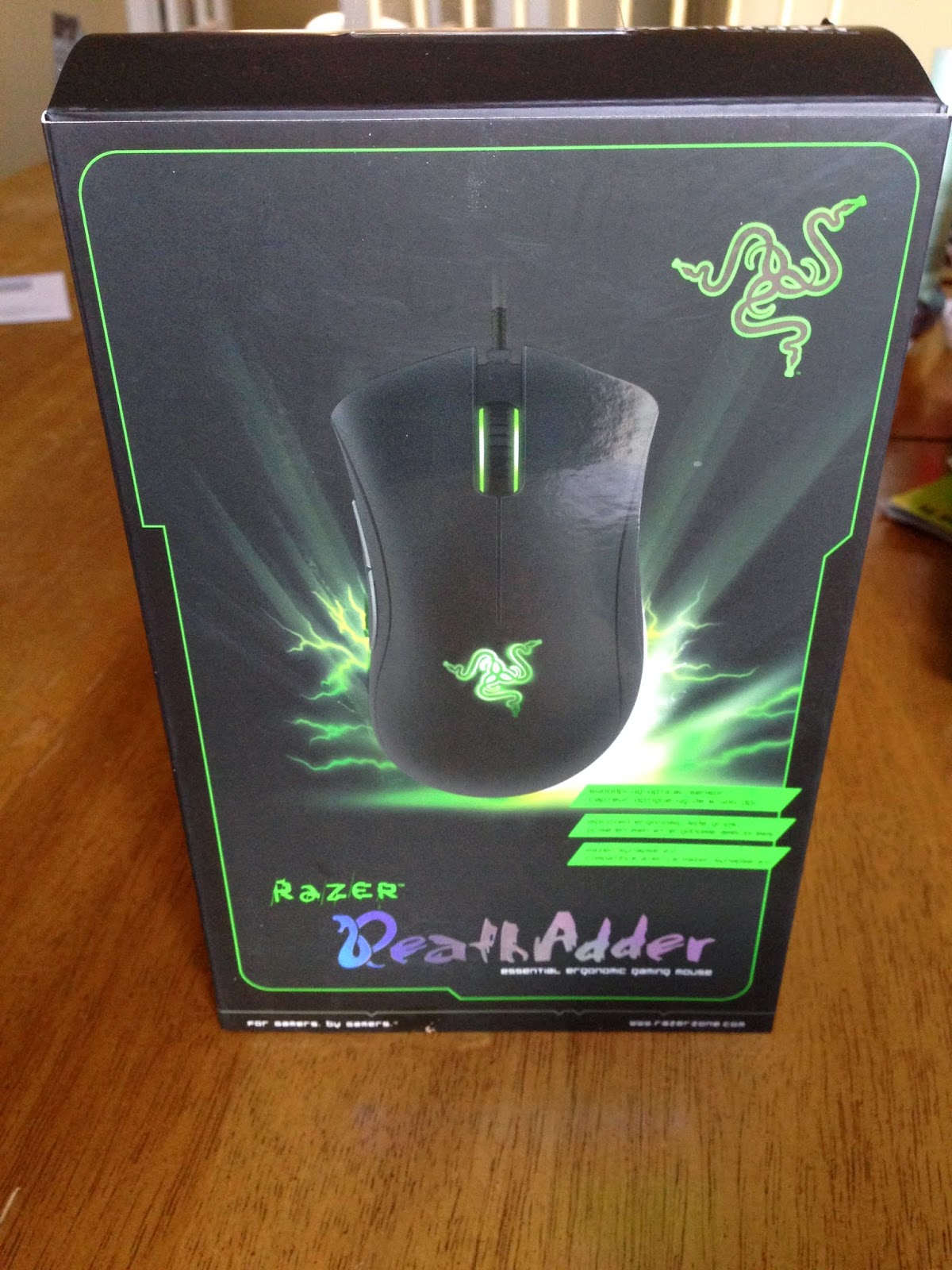
Razer DeathAdder, my first gaming mouse

Functional and Crisp

With only 5 buttons this mouse is unassuming,
let me assure you it packs a punch!
The words above are how I would describe the DeathAdder by Razer. Do not assume that the simplicity of those words implies a non-satisfactory product. Quite the opposite in fact. Let me start off by saying that this is my first "gaming" mouse. Prior to this I was using a normal run of the mill 2 click wheel job that was a hand-me-down from another gamer. Unfortunately it was on the fritz after 7 years and clicking double when I only asked for a single. 

So my wife went online and bought me what I wouldn't normally be willing to buy myself. I consider "gaming" paraphernalia to be frivolous. Not that I'm against it normally, I just believe that the extra $50 you would spend to have something fine tuned for gaming would go better toward other things in life. I believe that especially now that I have more adult responsibilities than I can remember on a daily basis. 

So when the DeathAdder came in the mail and appeared on my desk, I was surprised and relieved that I wasn't responsible for spending the money that was required to bring it to me. I quickly took it out of the box and threw my older mouse out of the way. Out with the old and in with the new! 

I found the Death Adder to deliver superior performance immediately. Even before downloading the software I noticed an immediate performance improvement from my previous mouse. The buttons activate at just the right pressure to allow for a tactile response but also quick reflexive movement. There was no delay or unnecessary pressure needed. This goes for the mouse wheel as well. It moved quickly and easily but stopped when there was no movement applied. It has defined and satisfying intervals that it stops at which is personally something I look for as I end up scrolling in many games I play and online as I surf the web. 

Added benefits to the mouse include 2 programmable buttons and amusing lighting effects. Now I've never been one for multiple buttons on the mouse. I prefer one hand to control movement with minimal other interface and one hand on the keyboard where all my buttons are. 2 extra buttons are plenty for me and they always have been. That makes for 5 clickables on the mouse and a rolling wheel for control. Plenty in my book and plenty to control any game I've come across. 

Opening up the software I had to look around a bit to familiarize myself. There are some minor inconveniences in the buttons on the UI that are counter-intuitive. Nothing that a bit of thinking didn't work out. After experimenting a bit I have to say that the "macro" feature of the software is interesting. I will have to try to come up with a good idea for macros but for now I'll just leave it alone. It seems to work very well and I had some fun programming pretty much anything into the buttons I wanted. 

The Death Adder next to my Saitek Exlipse II and their
complimentary lighting
Movement and DPI were very impressive. I don't know how much I will be able to recognize the difference between polling rates (the rate at which information is transmitted) but I do notice a massive difference in DPI ranges (dots per inch). The DPI range from centimeters to cross the screen to meters so there is a speed for everyone. The settings are automatically set so you test them as soon as you lift your mouse button which can be a bit jarring but is nice that the "apply" button is gone from the UI. It might seem like a small thing but it makes a difference in the perceived responsiveness of the mouse and program. 

Ergonomically it is shaped definitively for a right-handed player. It fits very well to the hand with no movement or adjustment needed. It is slightly angled at many points to keep the mouse firmly in place when moving the hand but without needing adjustment or a firm grip. I have average hands for the male population and I have to say that it feels perfectly natural in my hand while playing.

Since I haven't had any other gaming mouses fresh out of the box I have to say that I am very impressed with the DeathAdder from Razer. I tested it on DOTA 2, Don't Starve, Deus Ex: Human Revolution, and Kerbal Space Program. They all require lots of clicking and movement from the mouse and I never once found myself frustrated or fatigued. I have looked around at other mouses from other companies. Unless something else jumps out to me as revolutionary though, I think I'll be sticking with the Razer lines. 

You'll like this mouse if: You want a crisp, responsive, and enjoyable experience without too many bells, whistles, and doodads (perfect for any general gaming environment).  The UI matches this simple approach and brings nearly unlimited functionality to the mouse that is deceptively simple. There is no lack of customization that you apply with the combination of the two. The total experience is subtle but very satisfying. 

(If you have another opinion on the Razer line, let me know at @SimonGolden on Twitter!)

Sunday, January 25, 2015

Upcoming Space Sims and other stuff

Finalizing some games...(so here's an awesome Elite: Dangerous video courtesy of Ralfidue)

I tend to jump between games to get as much exposure to many genres as possible and lately it's been taking a toll. I know that I need to complete some of the games I've written about and I deserve to give others more attention. Likely that will take a while, so for now I'll be writing about interesting things that I see around the gaming community as I read news in my off-time. 

I remember about 10 years ago I picked up Freelancer for the first time. If you remember that title it probably brings with it very fond memories of hours upon hours spent drifting through space and collecting bounties or rare materials to sell later. After that game and it's cult following there was an unfilled hole in the market where developers dared not go. Making a space-simulator that appeals to the tech and science savvy audience requires lots of work and dedication to get right. Lash-back from the market would be unreal for games that were unrealistic or bare of features. 

That's why I am excited to see the development of Elite: Dangerous by developer Frontier (https://www.elitedangerous.com/). It's very reminiscent of Freelancer but is definitely a step up. I haven't played it for fear that my computer can't handle it. I may have to do something about that soon. The game looks gorgeous first off. The stars and galactic bodies make wonderful backdrop for the space-based fighting and mining that you can do. It is either Single or Massively Multi-player based on the choice of the player. I know that many games rely on designing around the basic concept of either, but not both. So I hope there is enough to do in the world to keep a single person occupied and entertained as well as enough features to allow mutiplayer structures to develop. Eve Online is the ultimate example of this, allowing for corporations and internal political struggles to develop and then writing about them after events in the game happen. The players and their fights themselves determine the shape of the game, not the other way around. 

Now as excited as I am about the comparison to Freelancer I can't help but mention the spiritual sequel that the developers from that game are creating. Star Citizen is set to release in 2016 and from the early material released looks amazing as well (https://robertsspaceindustries.com/). Right now it's just in public testing with limited access to materials. It looks just as amazing though it has a greater focus on space based dog-fighting. I think that it looks great but in it's own way there are more features developed and demonstrated for Elite: Dangerous.

Just a couple examples: the extensive marketing campaign that they've developed to show that any career is viable, and during many of the scrap-based missions there is a physical structure to both the cockpit and objects floating in space with proper sounds and physics. You might argue that they are built in different ways with different play-styles in mind, but those two things stood out to me as details that might not indicate the game is better, but definitely indicates a particular interest in detail oriented development that I don't see in the action shots from Star Citizen. 

They are in completely different phases of development though, so there isn't really a way to compare them until both products are finally released. All I want though is the freedom to earn credits in my own way, even if that isn't reliant on twitch based space combat. Getting on in my years I find my reflexes aren't as great as they were when I played classic dog-fighters like X-wing vs. Tie Fighter.

Other than that I'm getting around to finally finishing some of the games that I've been playing. I also want to get into the modding game and try making a mod for Don't Starve by Klei games. Mostly for educations sake and also because I think it would be fun. I am creating an automatic Dice Roller with electronics and probably going to be making a campaign for a recent tabletop RPG that I picked up for myself called Kromore (http://www.kromore.com/). I like playing all these games but it wears on you after a while since I only get limited time per day and I can't spend 8 hours a day playing games and reviewing them. 

Let me know if you have any experience with modding! I'd love to get some suggestions. Let me know on my twitter at @simongolden.

Sunday, January 4, 2015

Annual Releases and the Downfall of Quality Gaming

Quality vs Quantity


With the recent release of Assassins Creed Unity this year and the plans by Ubisoft to continue releasing games in the series on an annual basis, I have had several thoughts on this specific business model. Annual games are a sure fire way in the short term to push sales and increase revenue very quickly. There are models that make this business plans seem very profitable. And likely that is exactly what the aim is by Ubisoft. I mean they would be "stupid to not satisfy this need" (from the public for an annually released game) right? 

There are many things wrong with this thought, first of all the concept of quantity over quality. In basic economic terms Ubisoft has fallen prey to the classic duality of supply and demand. Demand for their flagship series rose exponentially for the first few games, so therefore a higher supply was required to keep up with demand. However with higher supply (games per year) will come lower demand. One might say that the fans of the series will remain being fans, and that new buyers will come into the market so demand will not fall with the rise of supply. 

However, I argue that when the first Assassins Creed game was released, the demand was so high because there was a severe LACK of supply. There was no game on the market that did what the original AC did at the time. And the new breakout mechanics were carried out so fluidly that the stock in that type of game skyrocketed. All of the sudden there were half a dozen more parkour-based action/adventure games in development as other developers saw the potential in the genre and jumped on the bandwagon.

However that was 2007 and now there are a multitude of games in this genre in so many different settings that the market can barely handle any more. I am not trying to state that there isn't a market for the games, but that over-saturation is a definite probability. Pushing more games onto the market also allows for gamers to be more discerning with their purchases as there are more choices. Extra Credits the YouTube channel on gaming made a very educational video about the concept of over-saturation and it's effects on the consumer. 

Ubisoft however does have a very large presence in the market, with nearly 10,000 employees and a revenue of over 1 billion annually (2008-2009). These numbers are formidable for any business much less one that is in the fickle gaming market. Since their model has worked so well this far, how then would it not continue to work? 

Saturation isn't the only concern moving forward with annual releases. With so many employees, coordination and quick resolution of problems during development falls apart and quality assurance can suffer accordingly. These problems appear to the consumer as the many glitches that have become a running source of comedy for the internet. 

Poking fun at the bugs and glitches isn't my intent, it is just the most apparent example of the lack of quality control that can pervade a company so large. This being said, is it quite the wise move to continue to show your hand and allow these glitches through on an annual basis without proper testing and quality controls? Being the giant in this genre and the parkour/combat sub-genre that Ubisoft is you would think they would like to lead the market in innovation and quality instead of making fast plays for cash each year from their fans. 

I have been reading a book by notable economic writer Jim Collins, called Good to Great, that addresses this type of company and their competitors. The truly great companies that overcome the market and surpass even their most successful competitors are the companies that focus on Quality rather than Quantity. This may seem like common sense, and something that is taught as a common technique in business but it seems to be all but failing in the interactive media sector. 

I'm not trying to say that annually released games like WWE, Call of Duty, and now Assassins Creed aren't quality games. However they come from giants, that have the option of creating ludicrously high levels of quality and innovation. Disappointingly however these companies have chosen to deny excellence and settle for an approach that is more akin to a company that is depending on an eventual takeover by a competitor. Ubisoft was a company that once made high quality content and that is where they made their name. Now that name has been sullied with poor decisions by showing a lack of respect for the community that once made them great. It is this writers hope that one day they will make their way back into the good graces of the community and once again become the leader of the industry they once were. 

(If you had a different opinion or a new video game to suggest, leave a comment below! If you want to recieve regular updates, follow me on Twitter @SimonGolden. )

Wednesday, April 16, 2014

"Modular Plot" will be the next big innovation in gaming

New changes in the way we see plot could lead us to more interactive worlds to play in

As I sit in my living room watching my wife play Bioshock Infinite (and occasionally chiming in) and having an amazing experience, I can't help but notice the story unfolding in front of me and think about the things that Ken Levine (Infinite's lead developer) said in an interview with Polygon last year:
 "Look, I've been thinking about narrative a lot and the future of narrative and how to make narrative...I've been working on a concept I call narrative LEGOs which is how do you take narrative and break it down. What are the smallest part of narrative that you can then remix and build something out of? Mix and match."
Now I haven't seen any sign of what his next project is going to be, but this statement in the interview excited me. Think about all the possibilities of a world where plot points don't exist to merely develop a story. A world where you aren't inexorably thrown toward a predetermined course and given only superficial choices. When every choice has a deep and profound consequence on not only your world but the story of your avatar, what would you do?

My interest probably boils down to reading too many choose-your-own adventure books as a child. I loved to see where my choices took me, and how they could end the story in an instant on the next page. Everything mattered and there were no pigeon-holed points where I needed to pass through to reach an exciting conclusion. The suspense was palpable and consistent. It's only too bad that games these days fall short of something that was perfected 20 years ago in written word.

The problem with modern gaming plot is exactly what I just mentioned, pigeon-holed plot points. Plots these days are meant to tell meaningful stories through the narrative of specific points of the game. An emotionally impacting event or a menacing enemy all add up to develop the characters and story in order to reach an exciting climax and conclusion. Both of which are most likely also predetermined in some fashion or another.

This is your standard plot in modern games. There are choices but the eventual outcome is a straight line.
Take an example of two games that claimed to hold choice, but both based their conclusion on a final choice; Fable and Mass Effect 3. The endings of those games were vastly different based on your choices (namely the last one you made). However you still reached that point in space and time, where that choice was made, and your character made it to determine what "ending" you would see. What might happen at the end of the game where you aren't at the tipping point of the world/galaxy? Where a choice along the way makes your characters plot bypass that exciting climax entirely! In the cases I mentioned, the world would have ended, but isn't that an ending in itself?

That may not sound exciting initially, but if you consider a world where these plots were intertwined, and the entire world did'nt depend on your performance or influence, then the world itself could develop around you. The influence of the main character would become secondary to the development of the world unfolding based on it's history and current events.

I'm getting a little ahead of myself here. Think about when a single event happens (like a battle where you might have the option to go and assist) and there is a lack of your characters presence; the entire battle would tip in the oppositions favor based on your preference. Those differences would reach back into your chosen plot line (by a visit from a broken and shattered man who is one of your friendly contacts) and show you the changes that were happening in the world around you where you might have had an effect (now that the entire community has been wiped out, plot lines that may have had a way to direct you through to that climactic conclusion of the biggest story are gone, and you must make due with your current life).

Bethesda has almost mastered this in the Fallout and Elder Scrolls games, except for their major plot points. No matter what you choose during your time, to complete the most rewarding parts of the game and see the reason you have been "chosen" you must pass through specific trials that are predetermined as your destined path. You can slay anyone who may have a job for you, or just wander the forest as a hermit. However choosing the obscure way of playing has no reward since it was added as a feature and not a plot device. The actions you take and their effect on the world, is different than having an effect on a successful plot.

See, a plot is hard to construct without control (or if Ken creates it, minimal control). Essentially, in a games plot there needs to be three major themes/events: the rise of the story, the climax, and the fall of the story following the climax. To build to that climax successfully, you need suspense, foreshadowing, character development, and intellectual and emotional investment from the audience. Without a definite climax or fall, building a plot rise to ambiguous points is difficult. Which is why all developers include plot or space-time chokepoints in their stories to develop the plot successfully no matter the characters choices.

Now imagine a world where there are not specific plot points you must reach to move YOUR story along. Where predetermination is generated from within the gamer instead of by the developer. Where the smallest portions of the world are ready to be attached in a tapestry and the thread is held by the gamer. You may care about helping the needy, or fending for yourself, but both lead you in different directions entirely. There is no "final boss", only those people and beasts that act as obstacles to the goal that you set for yourself.

Simplified, this is what I imagine the plot lines of Ken Levine's modular plot driven game to look like.
Unfortunately this kind of world building, would take a very long time and require massive resources; unless you could find a way to make these choices act in a modular way. Where you could control portions of the plot, but not the eventual outcome for the player. Where you could master the art of "Plot Legos" and deliver a world where outcomes of some plot modules either restrict or open other plot modules in an inconspicuous way. And eventually deliver you a story that is at least partially unique to you as the audience.

If anyone can break this barrier and introduce the gaming community into a new era of gaming based on choice, I believe that Ken Levine can. Even as I watch my wife get slaughtered over and over in the tale of Booker Dewitt, I know that somewhere out there she may have chosen a different path, and sadly she might never have played Bioshock. Now isn't that exciting?

"Heads or tails?"

Saturday, March 29, 2014

Acquisitions: Oculus, Facebook, and the future

Facebook delving into the hardware industry.


Checking his Facebook page and playing a game will soon look the same

I've read a lot of comments and memes lately about the acquisition of Oculus by Facebook. Many of those things bad, since there were so many companies and people that personally invested in the Oculus Kickstarter campaign. I understand the position that the community is in, however I can also see that this can be a good thing in the bigger picture.

First off, I want to make it clear that I understand the bad blood between some of the community and Oculus. The idea of Kickstarter was to give good ideas a chance to shine in a world where mega-corporations have so much control, and so many patents that they stifle independent developers. It is supposed to be a way for those developers to get started and provide a well made product for the public that isn't tainted by the profit driven corporate structure of public companies.

Unfortunately, new technology takes quite a long time to develop and perfect. Not to mention mistakes, and dead-ends in that development that cost money without profits. Trying to fund a research and development with production through a single Kickstarter campaign is practically impossible. Especially when you consider that this technology is going to take possibly decades to perfect and make affordable.

That's where Facebook comes in. Most people don't understand that these mega-corporations acquire smaller companies like this to expand and push resources at the technology so they can develop it faster and better. Yes, they're going to release it for profits later on, but it's still in the best interests of the average consumer for the technology to be developed by a larger company with more resources.

This also marks the first major step by Facebook into the hardware scene. So far they've been mostly software driven, and there haven't been any recent developments in hardware from the company. As a mega-corporation venturing into the hardware scene for the first time, they will try to make this work as hard as possible. Everyone may see this as a scheme to push Candy Crush closer to your face, but Facebook is going to work it's hardest to make sure that Oculus is perfected and successful.

In the end isn't that what we want? A successful VR product that we can use for at out leisure? We've all seen Bad science fiction movies, we know where VR will go eventually. We're all going to have social experiences across the globe through audio-visual simulation eventually, it's only natural that a social company acquires them now. It won't restrict it to Facebook, or social media I'm sure. Oculus will become a multi-faceted and capable platform for many different types of developers to create content for.

So maybe instead of raging about something that seems illogical and greedy, we can recognize that eventually this will create an opportunity for Oculus to develop into a new and better technology. It will definitely lead to the Oculus coming to market fruition faster. Maybe.

(If you had a different opinion or a new video game to suggest, leave a comment below! If you want to recieve regular updates, follow me on Twitter @SimonGolden)

Sunday, March 2, 2014

Naughty Dog and the reason they're so good at what they do

Developers giving us what we want, and what we need.


Recently in an interview with WIRED about the DLC for The Last of us called Left Behind by Naughty Dog, the creator Niel Druckmann said some very interesting things about development and the industry in general: 

"We’re very lucky at Naughty Dog that we get to make our own calls. No one outside of Naughty Dog tells us what to do. But I know when it comes to marketing or other aspects of the industry, those calls are sometimes very precedent-driven. So without being able to point to a game and say that can succeed on the market, you’re going to feel a lot of pressure to not do that. We’re lucky at Naughty Dog that we can ignore those recommendations, but in a lot of other studios, I’ve spoken with people in those studios and they cannot."
Seeing this quote made me think of Apple in their latest decade, and pushing a product on the American public regardless of what they voiced that they wanted. It was because they knew what the public would buy and not what they wanted that made them successful. If you read about Steve Jobs, he wasn't a people pleaser, and he didn't want his company to do that either. He was there to provide a quality product that he knew was an innovation and that lacked the complexity that comes from attempting to meet every demand of the public.

The problem with this inevitably is that you have clashing concepts and eventually have an absolute mess that ends up alienating the audience that you started with. A good example of this is the Call of Duty franchise that brought innovation and quality originally to the First Person Shooter scene. Now through the years though they've alienated the original audience and has created a new one with their consistent annual releases. This came about because the marketing team wanted to push the concepts that everyone liked about the original series and keep profits flowing.

Examples of the opposite however are Naughty Dog and their Uncharted series, the original Halo, and the upcoming release, Titanfall. These games have a clear vision that the entire development team shared, and they didn't look for popular features to implement. They took stable, and well-known ideas and built upon them to create something that was high quality, and more importantly could be mutually owned as a concept by everyone on the team.

I won't get into team dynamics and why this creates room for innovation, but it shows with the quality of game that these teams publish, and the continuing titles that they develop. Putting profits as a second priority to quality will create a product that, long-term, will overtake profitable but quickly developed games. Applying the observed rules of economics and production here can do wonders to see why some game series do wonderfully, while some lose quality in consecutive iterations.

Other News - Steam Sales

This week Steam released a statement saying that developers would now have full control over the sales on their games, instead of being controlled by Valve in their sales. I'm looking into this and the ramifications that other markets have had to find something to compare it by. Free market and the ability to lower and raise prices is a great thing, and I think it can have some great effects on sales. I'm all for companies selling their product at a lower price point if they want to make a more popular product, but I know there are some dangers in rampant price bidding as well. Hopefully this helps both the consumer get more for his money, and helps indie studios that are struggling. I want to see everyone get what they want, and hopefully this lets them have it. 

Anyway, I'm not going to be able to review a game today, and that's why I'm only writing about news that I found interesting. School, fatherhood, and work are taking a toll on my life this week and last, and I'm going to need a few days to recover. Don't worry, (I'm saying this to myself as much as my imaginary audience) I've got 40 games installed on my computer right now waiting for play-time and review, so I'll get the "3 days of..." series back up and running again soon. Nothing will stop me, believe me.

(If you had a different opinion or a new video game to suggest, leave a comment below! If you want to recieve regular updates, follow me on Twitter @SimonGolden.

Tuesday, February 18, 2014

Good Corporate Choices in Gaming: VAC vs. Cheaters

Lessons from Valve are always valuable.


Recently, Gabe Newell posted on reddit about some bans that happened because of their anti-cheat system, called VAC. When I read this post, I hadn't even heard about the 570 cheaters banned for linking their accounts to cheat servers. So that tells you how fast they replied, since gaming news is about the only news I follow. This should be lesson number one learned from Steam and Valve consecutively. Know your policies, and act on them quickly. 

Gabe knows his policies and seemingly so does his company. They've always been very consistent about providing the best possible gaming environment for their fans, and the increasing popularity of Steam just shows that it's working. Putting another feather in their cap here just makes their many plumed business plan shine that much more.

Basically what they're saying is that cheaters aren't tolerated, and at the same time, they are given many chances to right themselves. The avenues that VAC uses to determine cheating are none too short, and very fair as Gabe explains in his lengthy post. Honestly, I didn't lack faith in Valve, but if anyone did this post should squash that distrust with fervor. 

This type of exposition is a breath of fresh air. From the convoluted press releases that I'm used to seeing from EA, and the lack of information from other developers, a divide from developer to consumer has formed. It's uncomfortable and unnecessary. Most of their audience who is concerned with this type of news can easily decipher subtext from context. So telling it how it is, with specific references to cache and parsing is probably the smart thing to do, as Valve has promptly demonstrated.

I wish more companies would stop trying to fool themselves into thinking they can pull the wool over the eyes of their public. The public they serve are the tech savvy, the IT gurus, the hardware hackers,  that inevitably will find the truth no matter how much you try to hide it. So the next time a large corporation finds itself in a dilemma, maybe the best thing to do is just to tell the truth, and trust the public you have invested so much time and money into. If you can't trust that, then maybe you should re-evaluate what you're doing.

Friday, February 14, 2014

Fallout from the Indie Gaming Bubble

How the Indie Bubble is forming

I was reading some news on the Video Gaming industry and I came across this article by Joystiq on the indie gaming bubble. The phenomenon is well known especially in the technology sector in the last 10-20 years. The dot-com bubble, the mobile bubble, the real-estate bubble. All these are recent examples that anyone, young and old, should vaguely recognize. The bubble represents the rise of a new technology, and the resulting bandwagon of start-ups that try to grab on to this new economic gold-mine. Really, they start popping up left and right, good, bad, it doesn't matter. When a bubble forms everyone wants a piece. 

Joystiq in their article mostly addressed how the developers feel about this bubble. There was one quote in the article sums up how any indie developer should see the market now. Retro City Rampage creator Brian Provinciano explains it best: 

"The big challenge we now face is saturation, quality and protecting platforms from the race to the bottom, which happened to mobile. It's been a bit concerning to see that this most recent Steam Holiday Sale saw developers doing deeper discounts than last year, no doubt in an effort to try and rise in the charts against the ever-increasing competition. However, it's a very slippery slope, and if this continues, it will once again become less viable to be indie."


Steam and GoG are the current propagators of the indie bubble,
and a good indicator of when things will start turning south.

What the scene will look like after it pops

Historically, when there is a bubble in the economy, it boosts production, and quality for a while. It lowers prices and makes everyone all giddy over the possibilities. However like any bubble it's got to pop. From what I've seen of the over saturation on the Steam store, it's beginning to happen already. Games are green-lit to go on Steam with very little following, and in order to appease the masses, Steam is lighting up more and more games, regardless of the assurances or quality of the product.

Historically, two things happen when a bubble pops. They take place on two sides of the situation; effects on the producer, and the consumer. The consumer up until the bubble pops, has a high perceived value of assets they gain from the bubble. Goods from the bubble are cheaper and easier to obtain, and have high relative value. When the market becomes well saturated, the consumer uses this perceived value to justify spending in high quantities. Much more than when they had to pay more for similar goods. When the bubble pops, people recoil in their spending, and suddenly there is much less to go around, especially to those who can't withstand the sudden drought of economy.

After the over saturation of digital marketplaces, we can expect this to happen. People will see a rise in prices, as indie companies try to improve their quality of games. Consumers will stop spending as much money on those games, and in general when they realize the back log of low-priced goods they already have. Indie companies will suffer as they can only sell games when there is a seasonal sale, and even then have to compete with other studios for the lowest discount to reach larger audiences.

Finally, indie studios that have to disband or go bankrupt will have to let loose massive amounts of developers that are qualified for a single type of job that may or may not be applicable elsewhere. When you have a bubble burst, you end up with an over saturation of the work force for that particular industry. Game developers, artists, and programmers will be everywhere, and there won't be enough jobs to go around because of the recoil from the bubble popping. Unemployment and a general distaste for the industry will prevail amongst those who cannot be hired, and they will apply their skills to other areas, as the pool thins itself out. 
Here's a good visualization of how a bubble looks when it pops.
The digital market is nearing the "New Paradigm" marker.

The good news?


The good news from all this, is that eventually the over-saturated pool from which developers hire will regulate itself to a lower number of higher quality individuals. Over time the quality of games will return to what the average should have been prior to the inflation of the economic bubble. So games will return to the AAA quality that we remember from the initial release of the XBox 360 and PS3. You remember? Halo 3, Modern Warfare, Oblivion, Skate. Games that bring new and exciting things to platforms will return with the talent returning from the indie scene. We might even see a massive conglomeration of indie studios form a new gaming corporation. the possibilities after the market re-establishes a norm will be endless. Until that happens, brace yourself, because the gaming community is most likely going to be weathering some hard times soon. 

You'll like the bubble if: You dislike all the indie games that are low-quality coming out on the market and want higher quality, if less quantity.

(If you had a different opinion or a new video game to suggest, leave a comment below!)

Thursday, February 6, 2014

Kickstarter News: Sinister, and the future of gaming hardware

Evolution will create the next controller, but what will it be?

For the last decade there hasn't been a large jump in video game controller technology. Many of us either use the classic keyboard and mouse, or the more ergonomic console controller. There hasn't been a major evolution since the original XBOX and PS2. Even modern day PC controllers imitate console controllers since their inception. There have been attempts at left-handed gaming devices that allow for WASD and hotkey commands to be mapped to keys that conform to the palm while you play your favorite MMO/FPS but they haven't turned out to be all that popular, except with the most eccentric and hardcore of PC gamers.
This is just one of MANY configurations that are possible.
With stagnation and demand just waiting for the right tool, Tivitas Interactive, a hardware deveoloper in Canada, has decided to pounce. Right now there is a Kickstarter campaign funding a new technology called Sinister. It is a fully customizable left handed gaming device, that allows for seamless integration into your current setup. It has haptic feedback and is designed to evolve as new modules are created. So you can truly create your own experience, and then upgrade it as the company creates more modules for future games. I truly support this controller, as its the first gaming device that is designed to evolve as time wears on instead of forcing games to conform to a single standard.

Think about it, games releasing modules to be attached to your Sinister device so you can use their exclusive control to make the game more interactive. I'm not saying that Sinister is THE device that will change gaming, but it's a step in the right direction. No new technology has really captured the market, and had the opportunity to change the way we play.

The thing is, that visual information can only evolve a bit further and then we will have true-to-life resolutions and then where will we go? Hardware is where we turn to make the next big step. Virtual reality with the Oculus Rift, or possibly new input devices is where we turn to change the way we interact, and bring us closer to a visceral, tactile experience. Being interested in hobby electronics I'm truly excited for this technology, as hardware improvements have been slow over the career of gaming. 

The new age of gaming will truly depend on hardware choices, as software reaches it's peak. I want to be on the side of progress and evolution here, so I'll be supporting the Sinister gaming device as much as I can, if only a meager amount. Right now Sinister is only at about 10% of their goal, but they've still got a month to go -- it's not too much of a stretch to imagine them attaining their goal before that time.

What do you think will be the future of gaming? The Sinister or something like it? Or does the controller represent the ultimate in gaming interaction?

Sunday, February 2, 2014

News in gaming this week: Nintendo's New Direction

Can an old dog learn new tricks?

From Starwarsclub123 on Deviantart
Recently the Nintendo of America CEO Satoru Iwata, sat down and took an interview from the Nikkei Asian Review. The portion of the review posted on their website was short, but very revealing on the direction that Nintendo will attempt to be taking in the next few years.

The question is, will it be enough?

Don't get me wrong, I love Nintendo as much as the next guy that grew up with NES and Super NES right under their extra-large CRT TVs. I remember fondly many a night where the warm glow of Super Mario reached out for me and took me to a new world full of wonder and possibility. Lately though it seems that most of those possibilities have been met, and it seems that the characters Nintendo uses to market it's brand are tired, and worn out.

The Wii U, since it's release, has garnered underwhelming sales figures, and shaken the confidence of investors as Nintendo has been scrambling to find a foot hold. Luckily the Nintendo DS has held up exceptionally well in the mobile market, but it still is beat out by the newly established gaming market on smartphones. In a controversial move, Nintendo originally decided that they wouldn't port Nintendo games to the extremely mobile IPhone and Android markets, though the Interview with Nikkei may show that they are regretting that decision.
Sorry Mario, overalls were so last decade.

The Mergers and Acquisitions that the CEO mentioned don't seem to be aimed at new technologies, but more following the Microsoft model of acquiring smaller studios with franchise characters that hold potential. The Nintendo company is still depending on the characters that are exclusive to it's system to sell it's brand, which is fine. That strategy has helped them in the past, and for all the market data, franchises make a ludicrous amount of money. Especially the newer ones. Which is why Nintendo needs to pull out the stops and get people to invest in new Wii-only franchises, so they can taste the nostalgia of other characters Nintendo has so lovingly kept alive (just barely).

Marketing, like Itawa said in the interview, is something they will be working on. He mentioned
"discounts to steady, regular customers", which I hope means that they will be implementing a PlayStation-Plus style system, where you pay a monthly fee, and get free games each month directly uploaded to your system. It would be a great marketing idea, to get people to buy their product, and get groups of consumers to flock to the Wii U, which is honestly what they need. Nintendo consoles are the only ones that haven't jumped on board with the discount train that followed the Steam Sales these last few years. You'd be hard pressed to find a great deal on a newer Nintendo game, even one that's been out for a couple years. They just don't settle, and that in turn is hurting their marketability.

Finally, when he mentioned quarterly earnings reports, and the difficulty in projecting sales? I've seen projections be accurate. It's been difficult, and you need someone who keeps a very, very close eye on the pulse of the gaming community, but I'm sure you could find a way to make accurate projections. The problem isn't projections, it's popularity, and Nintendo right now, isn't a currently popular idea in most gamers heads. The company and their products are outdated, retro, and quite honestly a bit boorish. Investing in revamping themselves, will help Nintendo compete in the long run. Otherwise we may see the Wii line go the direction of the Dreamcast, tossed out of the market by the bigger dogs in the pack.

(If you had a different opinion or a new video game to suggest, leave a comment below!)
 

Monday, January 27, 2014

Gaming this week: Bad Corporate Decisions

Where is the world of gaming going?

Following the news this week, and seeing some of the new things coming out, I'm acutely aware that Shadows of Mordor looks like Assasins Creed II. And it definitely does. I don't have a problem with more games like Assassins Creed honestly. If they can make the formula fresh, or put that code that made that game into another universe, I'd be happy with that.

Assassins Creed: Lord of the Rings. You can't unsee it can you?

What I don't like to see is nearly a blatant copy of the mechanics, with just different skins to push out a demo to garner interest in a game. I understand that many games in this generation are derivative of other engines, or code. But I see the gameplay demo in this Machinima video and I honestly can see just a world re-skinned to meet the demands of a director that wants to push out a demo.
We as a community have to encourage balanced derivative design, which is inevitable, with original mechanics and art. They have the art down fine in this game, it genuinely looks like the Lord of the Rings franchise. The mechanics however seem ripped directly from another franchise, which then just makes your game a Frankensteinian invention. This is why large game factory companies like EA get bad reputations but still make money, because they demand speed and results rather than innovation. So we end up with this style of game. Just to meet the demands of the public. So honestly if we want mechanics and art that are original, we as the public have to stop paying out for games that are just the result of game-mills.
Image from Kotaku.com
In other news, I saw the Candy Crush Saga developer King, and their lawsuit against The Banner Saga. The best opinion I've read so far is from this article from Tycho on Penny-Arcade. He hits the nail on the head. King has moved over the course of this lawsuit from saying that it's not the "word" they've copyrighted, it's that people may confuse "The Banner Saga" with "Candy Crush Saga". I'll say this, that if you're playing either one and don't know the difference with purely a visual, then you probably shouldn't be playing them. Not to mention that most of Candy Crush business isn't in the same market as The Banner Saga. It's not even on the Steam Store, which is where I'm sure The Banner Saga sold most of their copies of the game. Either way, I would hope that the courts have enough common sense to crush this at the lowest level possible. Then again, games have this enigma about them when it comes to courts, so I may just give up on believing the courts can handle this.

These two stories have something in common, we have to stop rewarding bad corporations for bad business decisions, and poorly designed games. My wife doesn't call herself a "Gamer" but I catch her on her phone crushing away long into the night. So what does that say about the culture of gamers? It's expanding, and we need to ensure that games like The Banner Saga have their place, and can't be pushed out of the way by companies that cater to "non-gamers" like my wife. I'm not saying that we need to stop King from publishing any more games in the future, I appreciate the addictive nature of their game and the ability it has to indoctrinate people who would otherwise not pick up a controller. We have to find a way for all these companies to co-exist, and maybe if gamers become shareholders, we can oust the CEO's that make poor decisions for the market as a whole, and install people that synergize with this new world culture of gamers.

That's how I want to believe the world will end up. Companies that communicate and listen to the masses, and honestly create good games for their loyal customers. 

Thursday, January 23, 2014

In-Between Discussion: What I like in a game.

This won't be long...

I just want to get out there what I like in my chosen medium of entertainment, namely video games. I'm no developer or programmer, and I've not played every classic dating back to the mesozoic era. I don't spend each and every day picking and choosing what title to play to completion. Since I have limited time on my hands, I've got to choose wisely. 

Just a tad more challenging...
Most of the things I enjoy are golden standards in the industry. Proper progression is probably my biggest initial marker to help me decide if I'll keep playing. If at its core the gameplay is mindless action sequences that stagnate; where there are no challenges that progress to create a larger sense of achievement, I tend to lose interest quickly. Story isn't enough. I'm not waiting for the next cut scene as a reward, seeing the results of my direct input, and finding the path progressively more difficult is something I need. Otherwise I feel like I've wasted my time and haven't challenged myself. 
 
Just a little darker...
Yes, I find a challenge entertaining, and relaxing if it's done right. Like a good workout at the gym can give you the sense of released tension, but for my mind. This leads me to my second flag for a game I'll enjoy, a well balanced beginners curve. If the tutorial is too long, or involved, or there are so many mechanics that the game doesn't explain how to do everything, I'll probably drop it. If I'm still discovering the way the game works 3 hours into the game, then there's something wrong. I'm  not talking about a metroid-vania style power progression. I'm talking keeping vital controls and functions of a game secret, until I stumble on them by throwing my controller against the wall. At the same time, don't lead me to proverbial water each time I have to do ANYTHING. That's just as averting as unexplained meters or terms. 

When I've found those two things, I'll look to the artistic style of the game. There is a certain look that I enjoy in a game. It's usually chibi outlandish looking characters, and preferably a dark theme. I like the feeling of hopelessness and dread, and overcoming it. That or ridiculous action with tons of other strangers I don't know. What I don't enjoy, and this is entirely subjective, is "realistic" looking art. Attempting to make something look as real as possible, or close to life as possible, just reminds me that I'm in the real world and just not there. Whereas a false looking world can make me zone out and suspend the reality around me. Odd I know, but that's just the freaky stuff I'm into.

And that's perfect, we've arrived.
And honestly, thinking about it, that's about all I need to make me a happy man. Follow the prescribed formula, throw in some mechanics of some kind, and a common sense approach to your game and I'll probably play it and enjoy it. Most of the games I enjoy are non-reality inducing, unconventional, and don't remind me of the world where I've got to go to work in the morning. GTA, I'm looking at you.

Sunday, January 19, 2014

In-Between Discussion: How Micro-Transactions can be good for everyone.

Customizing your experience, and owning it!

Microtransactions
Hats are always a good business model for FTP.
After recently playing Rift (an MMO with a FTP model and a wonderful Micro-transaction Store) I am taking a more in-depth look at how micro-transactions are affecting the world of gaming, and where they are headed as demand changes. I personally am a huge fan of the well developed models. Rift, being my prime example, allows customization of experience, not just a place to buy equipment. They give the player many different colored and textured models for pets, mounts, cosmetic equipment, and UI upgrades. Much of this has nothing to do with the core mechanics, but it still gives you the incentive to spend your hard earned money to increase your experience.

When you spend your money, you are seeing definitive and immediate results. Not stat increases or abstract concepts. You can see the wild animal that you're riding on, or the dragon follower that interacts with you as you adventure. These things become a part of your experience, and everyone will have a different experience depending on what they want to spend their money on. 

Now my first exposure to the micro-transaction scene was years ago, in mobile gaming. It's been around the android store for so long I don't even know when it started. The well made games operated around the same concept, hook the player with good mechanics, and then if they want to increase their investment in the game, the game increases interactivity and customization. They are ways for the player to have fun and help in giving the game a touch of their style. 

Then games began releasing the "Pay to Win" model. Star Wars Angry Birds is the perfect example of this; paying money to be able to win much more easily. Buying up extra super-power birds so you can surpass levels or earn the ever-elusive 3 stars on each level. This in turn earning you more power ups than the player can earn normally without the purchase of in-game money. Don't get me wrong, I enjoy supporting a developer when they've put good hard work into a game, just not when the game demands it of me to play well.

Does the consumer deserve to be hit with a brick wall when they can't do anything more with your free-to-play model? Is this really the right course to take, imply that they can't move further without investing money? Essentially I see this as a form of entertainment blackmail, and not something I want to further invest my money into.

DOTA 2 does it right when it comes to FTP.
I buy games in early access and support crowd funded campaigns that I want to see succeed. In the same way I'll invest into a FTP model, once I've been convinced (and it doesn't take that much) that the experience I'm paying for will be enriched. I will not however throw cash down for micro-transactions in a game that naturally feels cheap until I pay.

I like the Free to Play model honestly. I believe that in time, I will invest more in a game if I'm allowed to enjoy it freely to reward attention to details than I would just buying it right off the shelf. A game might enthrall me if I'm allowed to play it for a while for free, but I might never touch it if there is a large initial cost. Hopefully the FTP market is guided by popular demand and pushed toward this new, wonderfully inspired model of symbiotic enjoyment; and not just video-game blackmail.

Sunday, January 12, 2014

In Between Discussion: Graphics vs Aesthetics

If the next generation can learn anything from the last, it's this.

The feature video below is "Graphics vs. Aesthetics" posted by Extra Credits on their youtube channel here. The video gives a simple concept that lots of gamers don't consciously think about a simple format for discussion. This happens to also be one of my favorite concepts when it comes to judging and ultimately enjoying games.


See, I'm a big proponent that Aesthetics can make a game look and feel amazing no matter what graphic quality it touts. When I see games that have great graphics, but environments that clash with other elements in the game, I question whether or not I want to spend my preciously earned money to see how the story and gameplay flush out.

 Modern day graphics in consoles and especially on PC are amazing, and I enjoy having a machine that can render life-like scenes in front of me. But I don't want to waste half a day in a game that just takes a smattering of design choices without attention to what meshes well. Clashing colors, towns that don't seem to work well because they're underpopulated. Design choices in characters that don't make sense. These little things aren't directly apparent, but they can ruin the experience in a game as bad as the worst of bugs.

So to me, Aesthetics are possibly the most important aspects of a game. If I don't see proper aesthetic design choices, I know that I won't believe that this world I'm involving my time in will be enjoyable. If I don't enjoy it because of poor aesthetic, then it isn't entertaining like it should be. And sometimes it just comes down to a decent overall palette that matches the tone. If I could change one thing about the games industry, it would be to put more focus on this, and less to pure graphic hogging.