Saturday, September 13, 2014

6 days of...Broken Age!

Time well spent

Sometimes it's good just to get back to my roots as a gamer. I loved the Sierra point and click games from the 90's and somewhere in me I will always hold an attachment to those types of games. So when I heard that Double Fine would be releasing a point and click adventure called Broken Age after a VERY successful kickstarter I got excited. I loved Brutal Legends when I first got a taste of Double Fines work and I am definitely going to check some more of their games out after this. 

This is the prison that you have lived in your entire life, and the
game makes you feel this immediately without feeling forced.
Speaking of that Kickstarter, it was setup for 400,000 and made over 3 million. That's just nuts. The dedicated community behind Double Fine games just astounds me. They demand nothing up front because they believe that there will be a quality product coming from the money they donate. That speaks volumes to me about the faith and confidence the community holds in this company. If they decided to go more mainstream I think they could make a lot more money, but they would definitely lose a bit of their following. Too bad though, seeing a Call of Duty style budget go to Double Fine might get some amazing things accomplished.

Anyway, back to my time with Broken Age. I can honestly say it has got some of the most memorable and smooth transitions that I've experienced in point and click adventures. Often playing a point and click is like having a conversation with someone that spoke into a microphone years ago, and is expecting you to respond correctly in the future. It's a difficult disconnect to overcome and many games fall short. An example of this would be adventures that reference or give clues to your next action, but in a much more obscure way than is necessary so the player ends up not understanding.
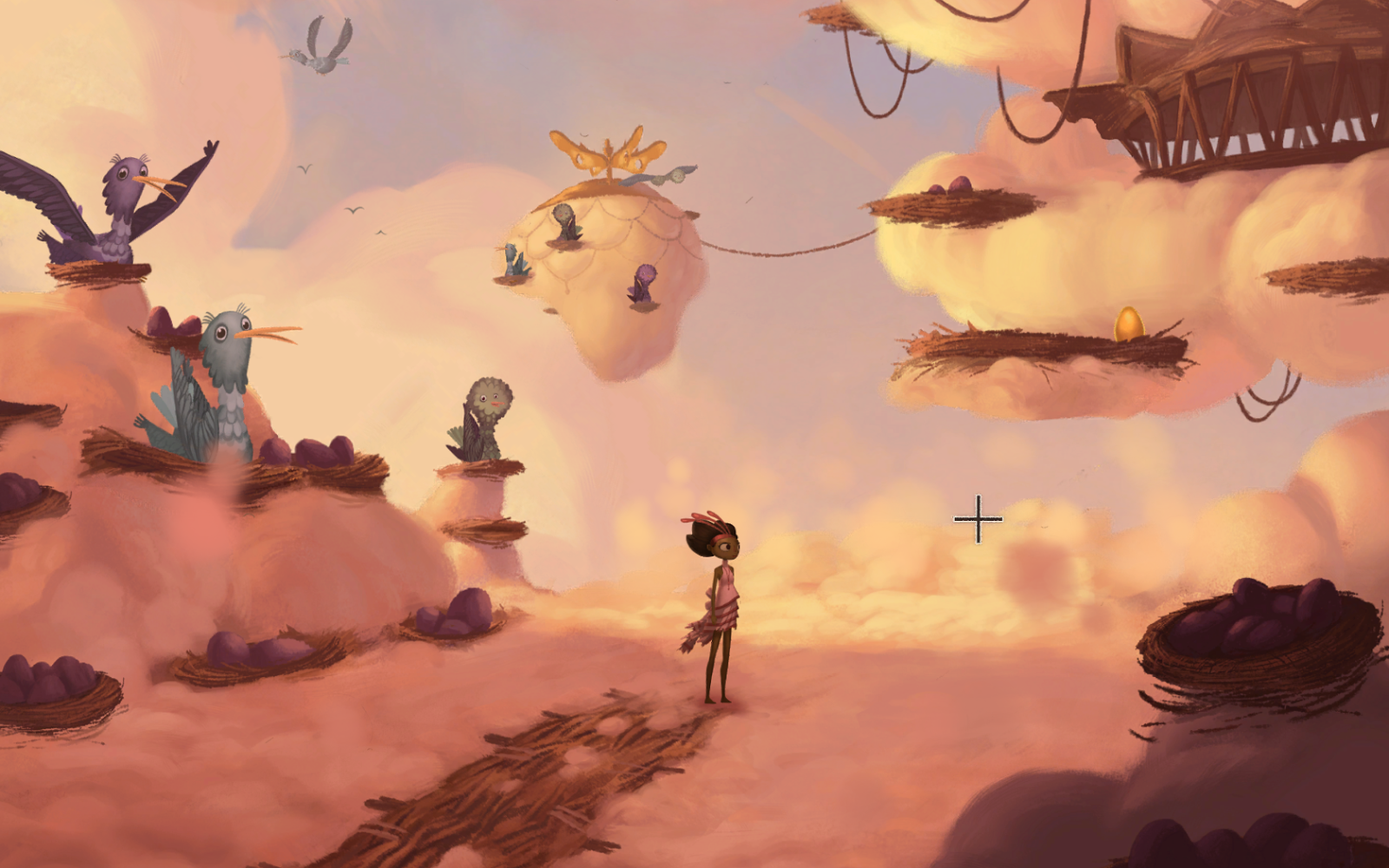
These portions of the story add incredulity and whimsy
but are engrossing at the same time.
However in Broken Age, it was neither obvious or obscure what action I was to take next. It was a perfect balance of clues and discovery. It felt like the world spoke to me and I responded each time, instead of being led by an overaggressive partner or abandoned to my own means. It was a genuine conversation between developer and player. In which no side came out stronger than another. 

I would attempt to bend the world to my whim, and the game would calmly direct me back to a path that was more fitting. I would push and strain to accomplish seemingly impossible things, and instead of getting frustrated I would just stop and enjoy the scenery. After a short period of time the answer would just come to me through an epiphany not brought on by an obvious hint but seemingly by my own intuition.

Instilling this in a player is a very, VERY difficult thing to do. It is a mystery to me how they did it, but Double Fine made me feel like I was genuinely exploring a new world and overcoming challenges by my own intellect, and not just stumbling along my way through a story. 

That being said the art is incredible. It's not detailed or special by any means, but the washed out pastels and some of the color changes between scenes really sticks out. The art also lends itself to the story because of the environments you find yourself navigating. The art makes each scene look like a children's story, but the story is much darker in context than the pictures would describe. It has a very Grimm feel to it. The story itself is dark and in some ways shocking, but it juxtaposes completely with the optimistic color and youthful art style.

This doesn't give anything away,
but I was frozen in shock at this point of the story.
It's hard to describe in some ways why it is so good, but if you enjoy point and click adventures, you should pick this one up. There will be more episodes soon but for now the game only takes about 5 hours to complete. That is only one episode though and there is at least a second episode promised to add on to the current story.

You'll like this game if: You enjoy point and click adventures and love stylized art an amazing speculative fiction story that will keep you enthralled for hours.

Sunday, September 7, 2014

6 days of...Mass Effect 2!

Everyone told me it would be great..

And in many ways it was. Mass Effect 2 by Bioware takes after it's predecessors that I've played. Since I picked up the game on a Steam sale and it's brethren were not so lucky to be discounted, I haven't played ME1 or ME3. So I don't have the save file that transfers the consequences of your actions or anywhere to go after I beat the game. But I have played previous Bioware games like Star Wars: Knights of the Old Republic, and more recently Dragon Age. I like Bioware's formula for games and especially the depth of story that they establish to create an all encompassing world that seems complete and detailed. 

Everything about Mass Effect 2 was great to experience.
Mass Effect 2 is no exception. Bioware put their heart and soul into this game and it shines through nearly every game play element. I thoroughly enjoyed playing it. What else is there to say about how good Mass Effect 2? It's pretty much been summed up in so many written and recorded reviews that there isn't much a single person could say that hasn't been said. 

That in mind, I think that there is something to be explored about the mechanic of choice as portrayed in the Mass Effect universe. This is something that has been touted as one of the accomplishments that Bioware is known for. Creating choice and consequence in a space opera that not only affects you and your team but an entire universe. How real is this choice though? Is it strong enough to break free of pre-determined course? Or just strong enough to create the illusion of choice? 

Free Will: Illusion vs. Reality

I will try to deny plot spoilers in this discussion, and instead focus on generalities. Strictly speaking you begin Mass Effect 2 as Commander Shepard and due to some circumstances are bound to the illusive man to help save humanity and the universe by revealing and exploring ways to defeat the Reapers. Starting out you are immediately tied to the destiny of a group of individuals and are made responsible for the survival of the universe. 

Of course it's implied multiple times that Shepard is the only one that can unite and save everyone. And so the responsibility is solely placed on your character. This is just the first choice that is denied you, the choice of responsibility. However that choice was made before even loading up the game, as you the player are already taking into your hands and putting on your screen a universe that you are taking responsibility for. Consent to become a savior is implicit in installing the game. It is your choice to play and when you play you are bound by the rules of the world you inhabit, the first one being that you must save the universe or doom it. That is your burden. 

Do we choose this path? Or is it chosen for us?
This non-choice at the beginning then is a real choice that was made by the player prior to playing the game. One might argue that you cannot choose to stop and do nothing in the game, and so it is illusion instead. However, this game is a STORY with a PLOT. It is not a simulator, as universal and ultimate choice would create. The parameters of the story are established and the choices after that are given to you are part of those parameters. One consideration is that in a story there can only be so much deviation before it loses its plot. 

Plot devices can change in minor ways but they cannot change in any way you decide to choose. Certain choices lead to consequences, but there must be some continuity in the main plot line along the way. Playing through the game multiple times, you end up in the same fights, with the same people. Often the only difference is replacing one character with another. In some scenes you are given a choice to magnanimously let people live or exercise wrath and cold calculation as you watch people die. This life and death scenario brings with it a deep sense of consequence to the choices presented. It is a part of our psyche to be impacted by death, especially of characters we are invested in. Is this choice real though?

The characters have minor plot devices in their backgrounds, and you can act on those plots to help them. You may even establish a friendship or relationship with some of them. The bond that Sheperd forms with these characters seems real and plays out with emotion and drama on the screen. So in choosing to let them live or die you break or strengthen that bond. Is that choice an illusion though? even though it has such an impact? 

I personally believe it is because of one train of thought. Implicit consent to become a savior of the universe puts you on a single path that must reach culmination to respect the boundaries of the universe you inhabit. By this I mean that beginning the game and accepting its terms implies that you will eventually finish the STORY that you have begun. Otherwise the initial choice is pointless, as the journey to the end of the story is the point of beginning it in the first place.

Once begun, the journey you are on places you in situations and gives you choices to develop the outcomes of lives around you. However regardless of your choice the fate of the universe will still be on your character, and the situations and missions you take on will continue to be very similar to what they would be regardless of choice. For example: a world may die because you did not cure a disease, however you will still fight that giant robot guardian on the next world with all or some of your friends. This robot is a plot device and an obstacle that needs to be cleared to satisfy the code requirements to continue the story. Are you affected by your choice? Possibly, but ultimately the choice does not matter as you continue on meeting these plot requirements. They are like domino pieces, and beginning the game pushes the first domino without any way to stop them from falling without just walking away.  

Final Questions

When does the illusion disappear and we believe this could be us?
This realization may be normal. Everyone might have it when they play games similar to this. What other devices are mere illusions in games? Using the same logic and exploring other devices we can show that everything is illusion in games. The improvement of skill in games is illusion because you are not actually improving, just increasing a number in a memory byte. The improvement of quality in graphics only improves as far as you can continue to create an illusion for the player, and the subjective opinion of graphics is relative to previous experience. So when does the illusion become reality then? When we cannot recognize the illusion? When does the change from illusion to reality occur? The difference is so subtle that we may not know until it is done, and then games will not only be a part of our lives, but may become our entire lives. If you experience something that is so real that you believe it to be reality, does that not constitute the definition of reality itself? The reality is that the thinking part of ourselves is only experiencing electrical pulses from the rest of our senses. If those electrical pulses can be manipulated and changed to suit a game, where does the boundary of illusion and reality exist? 

Going too far, bringing it back

These are some of the things I think about when a game gives me something that resembles "choice". Believe me, I think it's amazing that I can feel for digital bytes in the way that games like Mass Effect makes me do. I enjoy the choices and playing god, it's one of the reasons I play games in the first place. Being powerful is intoxicating, and playing games is the one of the best ways to do that. Mass Effect 2 definitely does that for me, and then some. It also has some great powers that are flashy to show off! You can even shoot a black hole at people! Don't tell me that's not awesome.

You'll like this game if: You enjoy space opera science fiction and like light bloom effects on literally everything. You may also enjoy the illusion of choice without having it or shooting black holes at people.


Wednesday, September 3, 2014

I'm Back!

Level Complete!

I'm just coming back to this blog after the last few months spent finishing off my Bachelors degree. Thankfully that is all over and I have the time now to get back to interesting and fun things during my free time. This means getting back to writing about games I do and don't like. I am still going to continue on with my Steam list and try to get all of them reviewed and in this blog. 

I feel like the problem with writing a blog about reviewing games is there are lots of sources of reviews out there that assign a score and say why it deserves that score. I'm a big proponent of the theory that every game has its merits and I want to focus on those merits more than the pitfalls that many games come across. In that way I'm going to try to start focusing on the things that the games I play do well and what I look forward to in the future from these features. Observing the evolution of games and looking for the traits that are strongest. Finding those traits in the next generation of games.

Also since I'm a business major I'd like to develop more of a temperature of the gaming industry and the strategies that modern gaming companies are following. These things interest me, and they give us a more personal view of the people and companies that are behind the games we play. Since this is my blog it's what I'll be writing about on occasion. Not every day mind you, but occasionally.

This is a personal project for me and in that way it will contain lots of my opinions that I will do my best to back up with facts or logical progression of ideas. I want to spend some time in dialogue about these ideas and get some clarity that I don't usually find other places. This is a legitimate industry that is rising to meet other media sources and I want to develop it in a legitimate way.

I'll be writing more soon!

BIG DAD GAMER

Friday, June 27, 2014

6 Days of...Dark Souls II!

Why I haven't posted in 2 months...

I've been ignoring this blog for some time, during which I've been busy with other things. Where laziness takes hold, life is my excuse. It's not a very good one since writing gives me great joy and I've been replacing the time I want to spend writing with a poison that has been slowly eroding my soul. Recently though I've had the desire to come back and revisit my project here, and I'll do my best to keep it going. I'll put this out there right now, DOTA 2 was my poison of choice. It took a majority of the time that I wanted to spend writing about games and threw it down the chute while being flamed by strangers and wasting may hours researching optimized builds that in the end didn't help me at all. 

However I've come to the conclusion that I'll not get better at DOTA any time soon. The personalities that I encounter there are not encouraging in the slightest either. It is few and far between where I meet somebody that makes the effort worth while, and even then it is only time until they become the poison I so hoped to avoid. So moving on to Dark Souls II, I was glad to leave behind the ability to speak openly to my partners. 

How Dark Souls II helped me recover

I will go on record right now as saying that I am biased, I love the Dark Souls franchise. I demonstrated this quite clearly with my review on Dark Souls. I consider the games to be complete, lacking for nothing that they did not attempt to include. This isn't to say that Dark Souls II includes everything that should be in a game, for that would be impossible. However they do establish a very clear cut view of what they want to accomplish at the starting gate, and every turn thereafter delivers completely.

Challenged for the right to live.
When I began Dark Souls II I was met with a generic idea of a life left behind and the cursed path which I am compelled to follow. This was reiterated to me by a band of witches that delivered me a message about my doomed life as an undead walking a solitary path, with nothing else to do but complete it and begin a new cycle or fail and be replaced. It is clear to me that my life is now not my own but a piece of a larger picture that will not hesitate to replace me.

So began my journey into a desolate waste of a former kingdom with undead, dragons, giants, and death waiting around every corner. I personally played a character specializing in hexes, a form of dark magic which is new to the second game in the series. Starting out in the small town of Majula, which would be more aptly described as a few small huts where undead merchants peddle their wares for souls.

From there the quests began, and I was filled with a sense of dread for what was coming. I died many times and followed many paths, all ending in the same place. This journey was taken silently and not taken lightly, but along the way spirits of undead present and past silently assisted in taking down the beasts and giants that stood in the way. 

This silence, eerie in the extreme brought a sort of brotherhood with it. It was understood that we all would endure the same torture and persist through our failures. Success would only come with time, and with time we all would become more hollow. This was all communicated with silent coordinated combat, overcoming the obstacles that would define our experiences until they slowly faded into their own world. Again to be lost to their isolation until the need arose to summon help in their own world, to form the bonds of silent cooperation and complete the circle. 

This truly is the way that games should be played, with pure intentions and lacking the corruption that human communication can bring. 

Always moving, never to hollow

The future of the blog.

Just for today, I wanted to write about how my experiences with Dark Souls II felt. I will be reviewing the game and all of its aspects later. This was just my general feeling during play which I believe is the most important part of the game. Too many times it's easy to just sink into the challenge of "beating" the game, but Dark Souls II is an experience that should be considered. It's been to me unlike anything before it, and shows me a different way to play. One where I can just enjoy the challenge of what's been placed before me and share it with another person silently. I consider this it's greatest achievement. 

If you liked the personal narriative let me know and I'll format some other posts like it. I might just reiterate my entire journey like this. Telling my story and putting into words the journey that we all face but do not articulate. It would be a pleasure to do so.

(If you had a different opinion or a new video game to suggest, leave a comment below! If you want to recieve regular updates, follow me on Twitter @SimonGolden)

Monday, April 21, 2014

New Post Coming Soon ON....DARK SOULS II

How to begin...

I've not been posting lately as much as I'd like, mostly due to the many hours I've been spending running around and beating Dark Souls II for my first time. It's so far been one of my favorite experiences lately in gaming and I'm going to be glad to write about it. Unfortunately that's where I get stumped.

There are so many great things that I'd love to talk about when it comes to Dark Souls that I could write for days. I could write a book on the nuances of the world building or the combat system. I've made a study of the series (including Demon's Souls) and I don't want to leave anything out. That's one of the reasons I'm putting it off, just so I can get my head wrapped around what's important, and also so I can get the rest of my life in order before putting pen to paper.

I love blogging about games, especially getting into the nitty gritty about the great things that each game I play brings to the table. Playing and developing games are two sides of the same coin, and I'd like to think that someday I may have an insight on the best qualities of the medium and be able to communicate to an audience about some of the components (ie. plot, setting, level design, character development, gameplay) that individually make games great. 

I'd like to bring that boring literature analysis that we've all had to go through (Ahem, English 101) to gaming, and take a critical look at the things that capture our attention and capture us for hours on end. For me, From Software have done so many unique things correctly with the Souls franchise that I'd like to give the series the time it deserves. 

Right now however, finals are upon us, my 2-year-old is brutally defiant, and work is as busy as ever. So I'll have to keep thinking in the moments between projects about how to begin my analysis, and find some time in my schedule to actually get around to writing about the series in a way that I find fitting. It's just a little pet project of mine that I'd like to bring a certain level of quality to.

Wednesday, April 16, 2014

"Modular Plot" will be the next big innovation in gaming

New changes in the way we see plot could lead us to more interactive worlds to play in

As I sit in my living room watching my wife play Bioshock Infinite (and occasionally chiming in) and having an amazing experience, I can't help but notice the story unfolding in front of me and think about the things that Ken Levine (Infinite's lead developer) said in an interview with Polygon last year:
 "Look, I've been thinking about narrative a lot and the future of narrative and how to make narrative...I've been working on a concept I call narrative LEGOs which is how do you take narrative and break it down. What are the smallest part of narrative that you can then remix and build something out of? Mix and match."
Now I haven't seen any sign of what his next project is going to be, but this statement in the interview excited me. Think about all the possibilities of a world where plot points don't exist to merely develop a story. A world where you aren't inexorably thrown toward a predetermined course and given only superficial choices. When every choice has a deep and profound consequence on not only your world but the story of your avatar, what would you do?

My interest probably boils down to reading too many choose-your-own adventure books as a child. I loved to see where my choices took me, and how they could end the story in an instant on the next page. Everything mattered and there were no pigeon-holed points where I needed to pass through to reach an exciting conclusion. The suspense was palpable and consistent. It's only too bad that games these days fall short of something that was perfected 20 years ago in written word.

The problem with modern gaming plot is exactly what I just mentioned, pigeon-holed plot points. Plots these days are meant to tell meaningful stories through the narrative of specific points of the game. An emotionally impacting event or a menacing enemy all add up to develop the characters and story in order to reach an exciting climax and conclusion. Both of which are most likely also predetermined in some fashion or another.

This is your standard plot in modern games. There are choices but the eventual outcome is a straight line.
Take an example of two games that claimed to hold choice, but both based their conclusion on a final choice; Fable and Mass Effect 3. The endings of those games were vastly different based on your choices (namely the last one you made). However you still reached that point in space and time, where that choice was made, and your character made it to determine what "ending" you would see. What might happen at the end of the game where you aren't at the tipping point of the world/galaxy? Where a choice along the way makes your characters plot bypass that exciting climax entirely! In the cases I mentioned, the world would have ended, but isn't that an ending in itself?

That may not sound exciting initially, but if you consider a world where these plots were intertwined, and the entire world did'nt depend on your performance or influence, then the world itself could develop around you. The influence of the main character would become secondary to the development of the world unfolding based on it's history and current events.

I'm getting a little ahead of myself here. Think about when a single event happens (like a battle where you might have the option to go and assist) and there is a lack of your characters presence; the entire battle would tip in the oppositions favor based on your preference. Those differences would reach back into your chosen plot line (by a visit from a broken and shattered man who is one of your friendly contacts) and show you the changes that were happening in the world around you where you might have had an effect (now that the entire community has been wiped out, plot lines that may have had a way to direct you through to that climactic conclusion of the biggest story are gone, and you must make due with your current life).

Bethesda has almost mastered this in the Fallout and Elder Scrolls games, except for their major plot points. No matter what you choose during your time, to complete the most rewarding parts of the game and see the reason you have been "chosen" you must pass through specific trials that are predetermined as your destined path. You can slay anyone who may have a job for you, or just wander the forest as a hermit. However choosing the obscure way of playing has no reward since it was added as a feature and not a plot device. The actions you take and their effect on the world, is different than having an effect on a successful plot.

See, a plot is hard to construct without control (or if Ken creates it, minimal control). Essentially, in a games plot there needs to be three major themes/events: the rise of the story, the climax, and the fall of the story following the climax. To build to that climax successfully, you need suspense, foreshadowing, character development, and intellectual and emotional investment from the audience. Without a definite climax or fall, building a plot rise to ambiguous points is difficult. Which is why all developers include plot or space-time chokepoints in their stories to develop the plot successfully no matter the characters choices.

Now imagine a world where there are not specific plot points you must reach to move YOUR story along. Where predetermination is generated from within the gamer instead of by the developer. Where the smallest portions of the world are ready to be attached in a tapestry and the thread is held by the gamer. You may care about helping the needy, or fending for yourself, but both lead you in different directions entirely. There is no "final boss", only those people and beasts that act as obstacles to the goal that you set for yourself.

Simplified, this is what I imagine the plot lines of Ken Levine's modular plot driven game to look like.
Unfortunately this kind of world building, would take a very long time and require massive resources; unless you could find a way to make these choices act in a modular way. Where you could control portions of the plot, but not the eventual outcome for the player. Where you could master the art of "Plot Legos" and deliver a world where outcomes of some plot modules either restrict or open other plot modules in an inconspicuous way. And eventually deliver you a story that is at least partially unique to you as the audience.

If anyone can break this barrier and introduce the gaming community into a new era of gaming based on choice, I believe that Ken Levine can. Even as I watch my wife get slaughtered over and over in the tale of Booker Dewitt, I know that somewhere out there she may have chosen a different path, and sadly she might never have played Bioshock. Now isn't that exciting?

"Heads or tails?"

Sunday, April 13, 2014

6 days of...FTL!

The best Star-Trek simulator that I've played

There's something about FTL and it's simple interface that makes it honest and pure. There isn't any of the fancy evasion maneuvers that wouldn't likely be possible in space during combat, and it's more of a naval-style space sim where you and the opponent slowly fire large ominous weapons at each other until one of your ships takes too much damage to bear the vacuum of space. It's also mind bogglingly difficult.
Recently the developers even released a DLC that is completely free to anyone who owns the game already. It ads tons of new content and re-works some of the old systems in the game to adapt to the new content. Passing out this new content for free is such a great concept to give back to a community that supports indie studios that it touched me and convinced me to write about all the great things this game does.

You've taken their data, now it's time to RUN!


FTL by developer Subset Games is a space ship simulator that puts you in the rank of captain of a ship and crew to pilot through a series of galactic sectors to escape a pursuing rebel fleet keen on capturing valuable data that you've stolen. You must survive every jump between stars and sectors to get to your allied base. Unfortunately space is unforgiving and you don't have the luxury of a well-fitted spacecraft. You must make due with a basic suite until you can upgrade your craft at small shops along the way.


This may sound like a dungeon crawler in a different setting, because it is. It's a rogue-like game that has a lot of the same elements disguised as different features in-game. Instead of abilities or spells you get weapons for your ship. Instead of levels you can upgrade the stats on your ship at any time at the cost of scrap from ships you destroy. Instead of armor you hire or find new members of your crew to increase your capabilities; depending on their training and the station console that they're at. You're going to need all of these things to survive and even then you most likely won't make it to your destination. 

To be honest, I've never reached the end of a rogue-like game. EVER. It's somewhat depressing to know that I've failed my favorite genre; but the same reason I enjoy the genre so much. The games make me think about how I could have done better and to avoid the mistakes I've just made in my next playthrough. FTL is precisely the same way. It is harsh and cruel, but fun comes consistently when the game shows you that you're capable of surpassing your previous record. It has a local and internet board where scores are posted, and you can see how you stack up to yourself and others so you can show marked improvement.
This is what you'll be dealing with a majority of the time.
It's well set up though, and displays information perfectly.
The difficulty of the game is frustrating sometimes, but every ship and event holds a strict set of causality based rules and is entirely fair even with some of the random number generation. You know what you're facing most of the time when you jump, and can prepare for it in one way or another. The game gives you the opportunity to upgrade at the correct times to meet new progression, and throws that progression at you at a fair pace to keep you interested. There isn't a long boring start-up process (like the rogue-like Don't Starve) to slow the game down in the beginning. This in turn encourages new runs and a better play cycle even though it is repetitive. 

Even though it's as repetitive as any other dungeon-crawler there are enough differences in the situations you can get into, the races of aliens you'll meet, and missions you'll have, to keep game play different and interesting each time. These circumstances play out in the form of text boxes to inform you of what's going on, but that classic text adventure plays into the computer data that you would be pouring over in a ship anyway; so I feel like it's not only adequate, but appropriate as well.

Visually, it follows the dogma of simpler is better. It's not necessarily lacking in the visual department, it's just simple. There are visual cues for everything and they are easily identifiable. It performs as well as any other good rogue-like in that way, though you're not going to be getting anything special. I like this though, since all you need is the vital information. It doesn't allow for anything superficial in the graphics so there aren't any glaringly grotesque mistakes either.

The sounds in-game are a bit simple, and the music isn't anything to die for. The sound effects give audio cues of everything that is happening in clear samples, that are not confusing in the slightest. This adds to the awareness you have of your ship to aid in survival of the journey through space, and definitely helps. However the simple synth tracks that act as background music could have been a bit more varied or interesting. It seems that there are just random computer-generated tones with a consistent baseline always playing in the background. There isn't a real variance in what you're listening to while blowing through pirates. It doesn't detract from the experience but I feel like it's a missed opportunity to have something great stand out. 

When I said that it's the best Star Trek simulator I've played, it's because it follows the same concept as many of the battles that I've seen the Picards and Kirks engaged in growing up. Slow lumbering flotillas charging and discharging weapons at each other. Engaged in a naval-style combat until one metal giant succumbs to another. If anything in science fiction, this is what space combat will be like in the future. Think massive battle fleets from the old naval battles of World War II meeting in space instead of on the high seas. That's what FTL is all about. Putting the force of your crew and ship against the force of the enemy and coming out on top. Or not, in some cases. 

Also, there are SO many mods for this game that you can probably find your favorite space faring vessel for download somewhere. Seriously, SO MANY MODS.
Look, mods like this. SO MANY.
You'll like this game if: You like rogue-likes, space combat, naval battles, or any combination thereof. Also if you want to see more slug, mantis, or rock inspired alien races duking it out in a ship that is on fire while evacuating atmosphere. OPEN ALL THE DOORS!